

We are living through a paradox.
On one hand, Artificial Intelligence has become the ultimate utility player in marketing. It predicts what we want to buy before we know it, serves us ads at the exact micro-moment we are ready to convert, and writes personalized email copy at 3:00 AM.
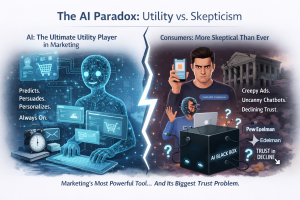
On the other hand, consumers are more skeptical than ever. We’ve all felt the “creepiness” of an ad that knew too much, or the frustration of a chatbot that couldn’t admit it wasn’t human. In a recent study by [Pew/Edelman], trust in institutions continues to decline, and the “black box” nature of AI is making customers nervous.
So, how do brands bridge the gap between technological capability and human confidence?
Here is how the smartest marketers are rewriting the rules of engagement in the AI age.
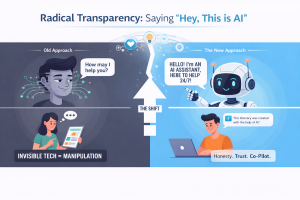
- Radical Transparency: Saying “Hey, This is AI”
For years, the goal of technology was to be invisible. Marketers wanted chatbots to pass as humans. They wanted personalization to feel like magic.
Today, that magic is starting to feel like manipulation.
The Shift: Winning brands are now labeling AI-generated content. Instead of hiding the machine, they are embracing it.
- The Approach: “This itinerary was created with the help of AI” or “Our chatbot is an AI assistant, here to help 24/7.”
- Why it works: Honesty disarms suspicion. When you tell a customer you’re using AI, you invite them to be a co-pilot in the experience. You are no longer “spying” on them; you are offering them a tool.
- Privacy as a Product Feature, Not a Compliance Box
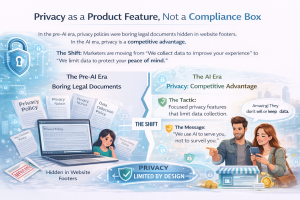
In the pre-AI era, privacy policies were boring legal documents hidden in website footers. In the AI era, privacy is a competitive advantage.
Consumers know that AI needs data to function. However, they are no longer willing to trade their privacy for convenience without knowing the price.
The Shift: Marketers are moving from “We collect data to improve your experience” to “We limit data to protect your peace of mind.”
- The Tactic: Apple’s App Tracking Transparency framework set the tone, but now SaaS platforms and e-commerce stores are following suit. Brands are running campaigns highlighting that they don’t sell data, or that they delete it after 30 days.
- The Message: “We use AI to serve you, not to surveil you.”
- Human-in-the-Loop: The Rise of the Hybrid Experience
There is a fear that AI removes the “human” from human resources. Smart marketers are using AI to enhance the human touch, not replace it.
The Shift: Brands are implementing “Human-in-the-Loop” (HITL) systems. AI handles the data sorting, but a human makes the final decision or crafts the final message.
- The Tactic: Rather than letting an AI autoresponder fire off insensitive replies to angry customers (a PR disaster waiting to happen), AI drafts the response and flags the emotion. A human reviews, edits, and sends.
- The Trust Win: This shows customers that you value judgment over speed.

- Explainability: Demystifying the Algorithm
One of the biggest trust killers is the “Black Box” problem. When a customer is denied credit, shown a higher insurance price, or excluded from a discount, they want to know why.
The Shift: Algorithmic transparency. Marketers are teaming up with data scientists to create “Explainable AI.”
- The Tactic: Instead of a generic rejection email, a fintech app might say, “Our AI model suggested this loan term based on your recent spending patterns and credit history. Want to see the specific factors?”
- The Psychology: People can handle bad news. They cannot handle secrets.

- Value-for-Data Exchanges
There is a growing sentiment that AI is just taking, taking, taking. It scrapes the web, takes our photos, and reads our emails.
The Shift: Marketers are now clearly defining the “Value Exchange.” If a customer gives you their behavioral data, what do they get in return that is tangible and immediate?
- The Tactic: “Turn on personalized recommendations to skip the search and get your look in 10 seconds flat.” Or, “Share your fit preferences to reduce returns by 50%.”
- The Goal: Make the benefit of AI so obvious that the trade-off feels like a bargain.

- Fighting Deepfakes and Misinformation
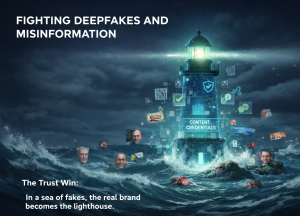
As Generative AI makes it easier to create realistic fake content, legitimate brands are having to work harder to prove their authenticity.
The Shift: Verifiable content and provenance.
- The Tactic: Some brands are beginning to adopt Content Credentials (digital nutrition labels) that show the edit history of an image or video. Others are using blockchain verification for certificates and receipts.
- The Trust Win: In a sea of fakes, the real brand becomes the lighthouse.
The Bottom Line
Trust in the AI age isn’t built by being the smartest brand in the room. It is built by being the most respectful.
Consumers are not Luddites; they use ChatGPT, they love Spotify Discover Weekly, and they appreciate when Amazon reminds them to reorder toilet paper. What they refuse to accept is being treated as a data farm for a corporate algorithm.

The winning marketers of 2024 and beyond won’t be those with the best AI. They will be those who use AI to prove they are listening, not just watching.