
Introduction: The Digital Landscape and the Need for SEO
Imagine you’ve just opened the most incredible store, filled with unique products and expert service. There’s just one problem: it’s located on a deserted street with no road signs pointing to it. How will customers find you? This is the challenge every website faces in the vast digital universe. With billions of web pages vying for attention, simply having a great website isn’t enough. You need a way to be found.

This is where Search Engine Optimization, or SEO, comes in. It’s the practice of optimizing your website to improve its visibility when people search for products, services, or information related to your business on search engines like Google, Bing, and others. The higher your pages rank in these search results, the more likely you are to attract visitors and, ultimately, customers.
Why SEO is crucial for online visibility is simple: search engines are the primary gateway to the internet for most people. If you’re not visible in search results, you’re missing out on a massive, targeted stream of potential traffic. SEO is the strategic process that ensures your business shows up when it matters most.
- What is SEO? A Clear Definition
At its core, Search Engine Optimization (SEO) is the art and science of making your website more attractive to search engines. The goal is to earn higher organic (non-paid) search engine rankings.
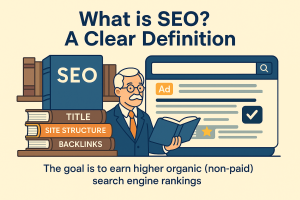
Think of search engines like a constantly updated library. SEO is the process of making sure your book (your website) has a compelling title (title tag), a clear table of contents (site structure), valuable content (quality information), and positive reviews from other authors (backlinks). This makes it easy for the librarian (the search engine) to recommend your book when someone asks a relevant question.
It’s crucial to understand the difference between organic search results and paid ads. Paid ads (Pay-Per-Click or PPC) appear at the top of search results with a small “Ad” label. You pay for that placement. Organic results, listed below the ads, are the “natural” listings that SEO aims to improve. While both are important, organic search typically drives the majority of search traffic and is perceived as more trustworthy by users.
- How Do Search Engines Work?
To master SEO, it helps to understand how search engines operate. They perform three primary functions:
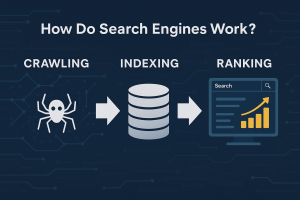
- Crawling: Search engines use automated programs called “bots” or “spiders” to discover publicly available content on the web. They crawl the internet by following links from one page to another.
- Indexing: After crawling a page, the search engine processes and stores the information in a massive database known as an index. Think of the index as a giant library catalog that contains information about every web page the engine has found.
- Ranking: When a user types a query, the search engine sifts through its index to find the most relevant and authoritative pages. It then orders these pages into a list of results—this is the ranking process. The complex algorithms that determine this order consider hundreds of factors.
- Core Pillars of SEO: A Three-Part Foundation
Effective SEO is built on three interconnected pillars:
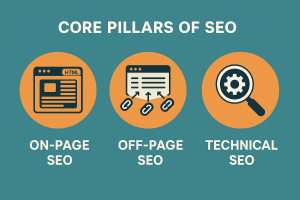
- Technical SEO: This is the foundation. It involves optimizing the backend of your website so search engines can crawl and index it effectively. Key aspects include site speed, mobile-friendliness, clean URL structures, and a secure (HTTPS) connection. If your site has technical issues, it’s like having a store with a broken door—no one can get in, no matter how great your products are.
- On-Page SEO: This focuses on optimizing individual web pages to rank higher. It includes elements that both users and search engines see, such as:
- Keyword Research and Usage: Identifying the terms your audience searches for and using them strategically in your content.
- Content Quality: Creating valuable, comprehensive, and engaging content that satisfies the user’s search intent.
- Meta Tags: Crafting compelling title tags and meta descriptions that appear in search results.
- Header Tags (H1, H2, H3): Structuring your content for readability and relevance.
- Off-Page SEO: This is about building your website’s reputation and authority across the internet. The most significant factor here is link building—earning backlinks from other reputable websites. These links act as votes of confidence, telling search engines that your content is valuable and trustworthy. Social media mentions and brand citations also contribute to off-page SEO.
- Why SEO Matters: The Tangible Benefits
Investing in SEO isn’t just a marketing tactic; it’s a business strategy with powerful returns:
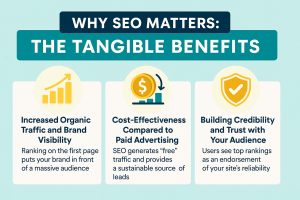
- Increased Organic Traffic and Brand Visibility: Ranking on the first page of Google puts your brand in front of a massive audience. Even if users don’t click immediately, they see your brand name, building recognition and trust over time.
- Cost-Effectiveness Compared to Paid Advertising: While SEO requires an investment of time and resources, the traffic it generates is “free” in the sense that you don’t pay for each click. This creates a sustainable source of leads and customers that can compound over time, unlike PPC, which stops the moment you stop paying.
- Building Credibility and Trust with Your Audience: Users inherently trust search engines. A top organic ranking is seen as an implicit endorsement, signaling that your site is a credible source of information. High-quality SEO, which provides great content and a good user experience, directly builds this trust.
- Common SEO Myths and Misconceptions
The world of SEO is filled with outdated advice and myths. Let’s debunk a few:
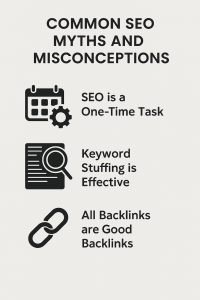
- “SEO is a One-Time Task”: Search engine algorithms are constantly evolving, and competitors are always working to improve their own rankings. SEO is an ongoing process of monitoring, updating, and adapting.
- “Keyword Stuffing is Effective”: In the early days of SEO, cramming keywords into content could boost rankings. Today, this practice is penalized by search engines. Modern SEO focuses on natural language and user intent.
- “All Backlinks are Good Backlinks”: The quality of backlinks matters far more than the quantity. A single link from a highly authoritative site like Harvard.edu is worth more than thousands of links from low-quality, spammy directories.
- Essential SEO Tools for Beginners
You don’t need a massive budget to start with SEO. Several powerful tools are available:
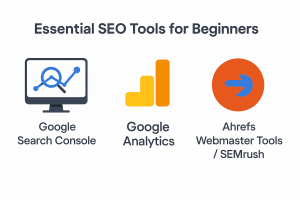
- Google Search Console: A free tool that shows you how Google views your site. It provides data on your search traffic, indexing status, and any technical errors that need fixing.
- Google Analytics: Another essential free tool. It helps you understand your website visitors—who they are, how they found you, and what they do on your site.
- Ahrefs Webmaster Tools / SEMrush: While their full suites are paid, these platforms offer free versions or trials that are excellent for keyword research and competitor analysis.
- The Future of SEO: Staying Ahead of the Curve
SEO is not static. To stay competitive, you must be aware of emerging trends:
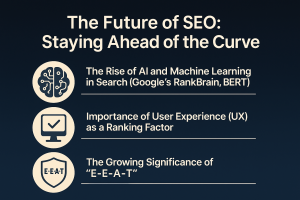
- The Rise of AI and Machine Learning in Search (Google’s RankBrain, BERT): Google’s algorithms are increasingly focused on understanding user intent, not just keywords. Creating content that naturally answers questions is more important than ever.
- Importance of User Experience (UX) as a Ranking Factor: Metrics like Core Web Vitals (loading speed, interactivity, visual stability), mobile-friendliness, and overall site usability are now direct ranking factors. A site that is easy and pleasant to use will be rewarded.
- The Growing Significance of “E-E-A-T”: This stands for Experience, Expertise, Authoritativeness, and Trustworthiness. Google uses these principles to assess the quality of content, especially for “Your Money or Your Life” (YMYL) topics like health, finance, and legal advice. Demonstrating your E-E-A-T is crucial for ranking.
Conclusion: SEO is an Essential Long-Term Investment
Search Engine Optimization is much more than a technical checklist. It is a fundamental marketing discipline that aligns your website with the needs of both your audience and search engines. By creating a technically sound, user-friendly website filled with high-quality, authoritative content, you build a powerful asset that drives sustainable growth.
While SEO requires patience and consistent effort, the payoff is immense: a steady stream of targeted traffic, increased brand authority, and a significant competitive advantage. In today’s digital world, understanding and implementing SEO isn’t optional—it’s essential for any business that wants to be found online. Start with the basics, focus on providing real value to your users, and you’ll be well on your way to long-term success.