
The way customers discover brands has fundamentally changed.
In 2026, the path to purchase increasingly runs through AI-generated answers. According to recent research, over 63% of B2B research now begins on AI platforms like ChatGPT, Perplexity, and Gemini. When a potential customer asks, “What’s the best CRM for small business?” and gets a synthesized answer that includes your competitors but not you, you’ve lost the opportunity before they’ve ever visited your website.
This shift demands a new discipline: tracking your brand’s visibility in AI-generated responses. But creating an effective AI visibility report requires more than a few manual searches. Here’s how VooTech approaches it.
Why Traditional SEO Reports Don’t Work Anymore
Traditional SEO measured rankings—where your site appeared on a search engine results page. AI visibility is fundamentally different. B2B brands optimizing their content strategy for Google are often invisible across ChatGPT, Gemini, and Perplexity, because each platform has its own citation model.
Research shows that while blogs and webpages drive over 90% of all AI platform citations, the differences between platforms are critical:
- ChatGPT is the only platform that meaningfully cites LinkedIn posts (1.1%) and Wikipedia (2.0%), and cites academic or research-backed content at 2.2%—more than six times higher than Gemini or Perplexity.
- Perplexity actively cites comparison pages and solution-specific pages at scale, making it uniquely important for bottom-of-funnel B2B content targeting buyers close to a purchase decision.
- Gemini shows the strongest preference for brand-owned blog content and avoids community sources like Reddit and Wikipedia almost entirely.
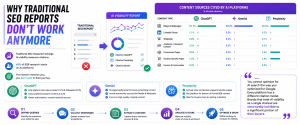
As one industry expert put it: “You cannot optimize for AI search the way you optimized for Google. Every platform has a different citation model. Brands that treat AI visibility as a single channel are structurally invisible to a significant portion of their buyers.”
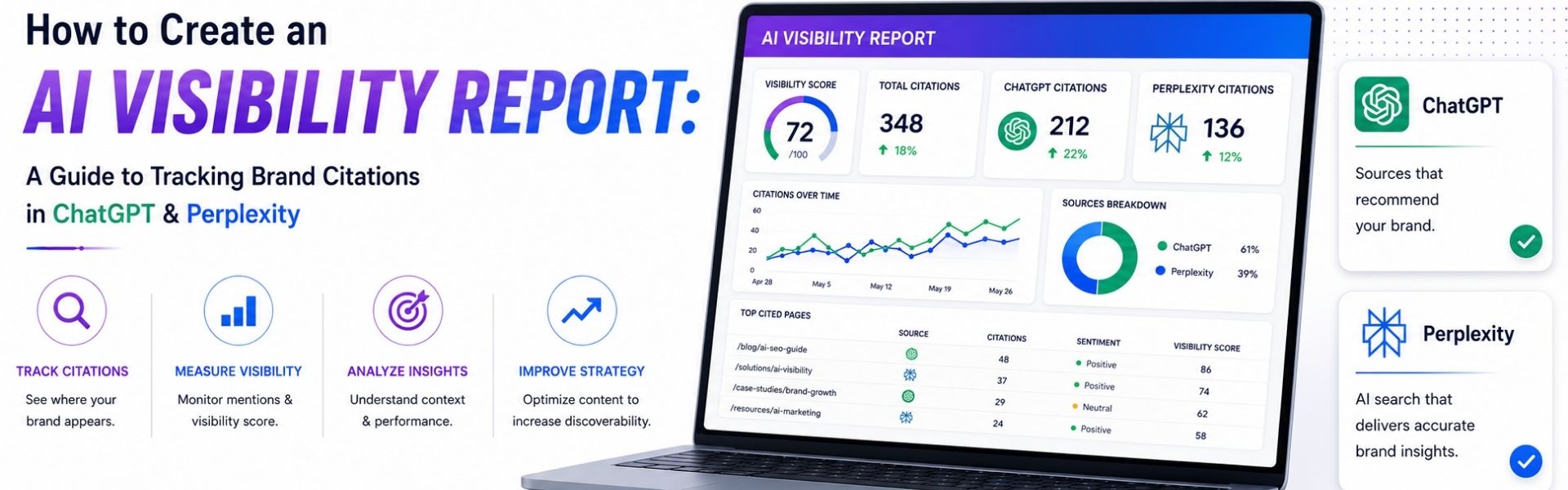
The Core Metrics: What to Track in Your AI Visibility Report
Building an effective AI visibility report means moving beyond vanity metrics. Here are the signals that actually matter.
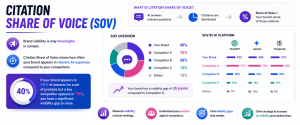
Citation Share of Voice (SOV)
Brand visibility is only meaningful in context. Citation Share of Voice shows how often your brand appears in relevant AI responses compared to your competitors. If your brand appears in 40% of answers for a set of prompts but a key competitor appears in 75%, you have a significant visibility gap to close.
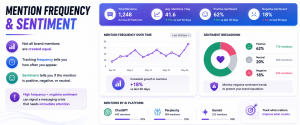
Mention Frequency and Sentiment
Not all brand mentions are created equal. Tracking frequency tells you how often you appear, while sentiment tells you if the mention is positive, negative, or neutral. A high mention frequency paired with negative sentiment scores could signal a messaging crisis that needs immediate attention.
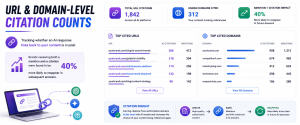
URL and Domain-Level Citation Counts
Tracking whether an AI response links back to your content is crucial. Brands receiving both a mention and a citation were found to be 40% more likely to reappear in subsequent answers.
Citation Position and “Top 3 Source” Rate
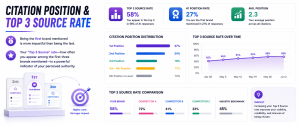
Being the first brand mentioned is more impactful than being the last. Your “Top 3 Source” rate—how often you appear among the first three brands mentioned—is a powerful indicator of your perceived authority.
Prompt Coverage
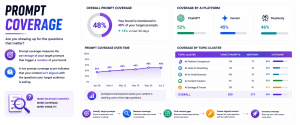
Prompt coverage measures the percentage of your target prompts that trigger a mention of your brand. A low prompt coverage score indicates that your content isn’t aligned with the questions your target audience is asking.
Cross-Platform Consistency
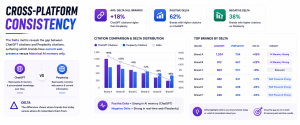
The Delta metric reveals the gap between ChatGPT citations and Perplexity citations, surfacing which brands have current web presence versus historical AI memory only.
Building Your AI Visibility Report: A Step-by-Step Framework
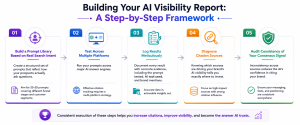
Step 1: Build a Prompt Library Based on Real Search Intent
Create a structured set of prompts that reflect how your prospects actually ask questions. Aim for 20–30 prompts covering different funnel stages and customer segments.
Step 2: Test Across Multiple Platforms
Run your prompts across major AI answer engines. Effective citation tracking requires a multi-platform strategy.
Step 3: Log Results Meticulously
Document every result with concrete evidence, including the prompt tested, AI tool used, and brand mentions.
Step 4: Diagnose Citation Sources
Knowing which sources are driving your brand’s AI visibility tells you exactly where to invest.
Step 5: Audit Consistency of Your Consensus Signal
Inconsistency across sources reduces the AI’s confidence in citing your brand.
AI Visibility Monitoring Tools
While manual tracking is a solid way to start, consider tools like:
- Yoast AI Brand Insights
- Apify AI Visibility Monitors
- SurgeGraph AEO Platform
- SEMAI
The VooTech Verdict
AI visibility isn’t a nice-to-have anymore—it’s the new frontier of brand discovery. The brands that will win in 2026 and beyond are those that understand how AI systems perceive them and actively engineer the multi-source consensus required to trigger high-confidence AI citations.
Ready to understand how AI systems see your brand? VooTech helps brands navigate the complex landscape of AI visibility, citation tracking, and generative engine optimization. Contact us to start your AI visibility audit today.