In the early days of generative AI, the mantra was simple: “Scrape the internet.”
Every blog post, tweet, and open-source line of code was fuel for the fire. But by 2024, the tech giants hit a wall. They had literally run out of high-quality human data to consume.
The industry faced a “Data Drought” that threatened to stall progress. Yet, in April 2026, the models are smarter, faster, and more creative than ever. How?

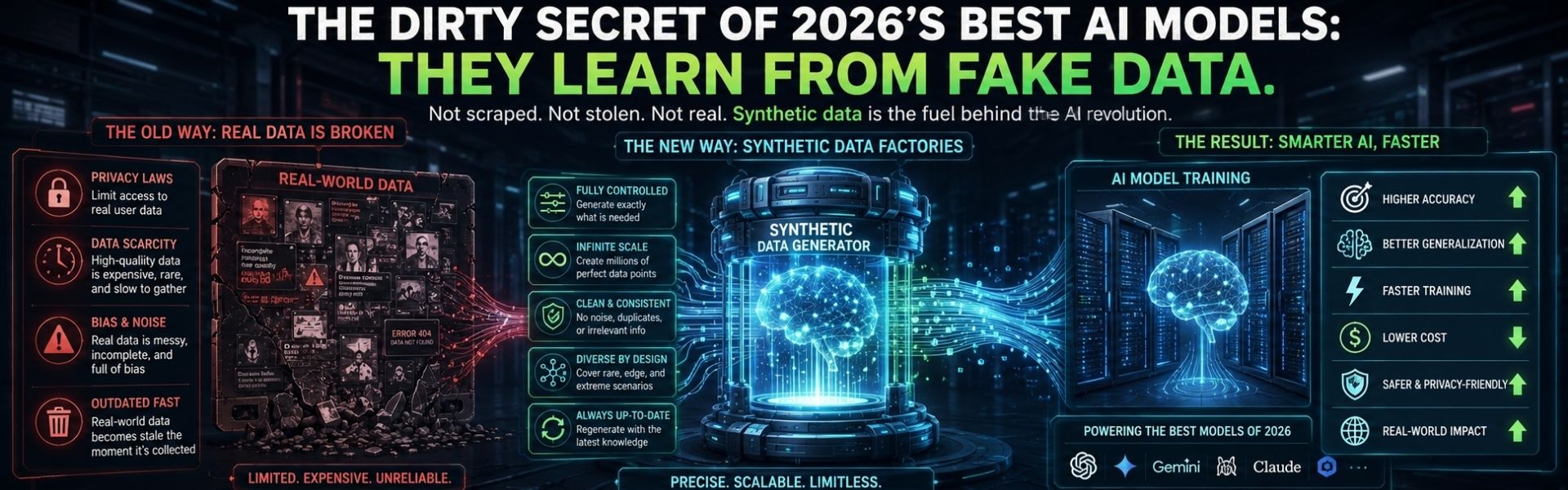
The answer is the industry’s open secret: Synthetic Data. The best AI models of 2026 aren’t learning from us anymore—they are learning from each other.
Synthetic Data Is Eating the World
We’ve officially crossed the “Synthetic Rubicon.” This year, it’s estimated that over 70% of the training tokens for flagship models like GPT-5 and Gemini 3 are synthetic.

In 2026, AI companies are no longer just “data harvesters”; they are “data manufacturers.” They use highly specialized “Teacher Models” to generate perfect textbooks, flawless codebases, and infinite 3D simulations specifically designed to train the next generation of “Student Models.”
Why it Matters: The Scarcity of the Real
There are three main reasons why “Real Data” has become a secondary resource:
- The Human Ceiling: Humans simply don’t produce high-quality, logic-dense text fast enough. To reach the next level of “Reasoning AI,” models need trillions of examples of perfect step-by-step logic—something the average Reddit thread or tabloid article doesn’t provide.
- Privacy & Regulation: With the EU AI Act and GDPR in full force, using “real” data (like your medical records or private emails) is a legal minefield. Synthetic data provides a “clean” alternative—it has the same statistical patterns as real data but contains zero personal information.
- Edge Cases: You can’t wait for a real-life car crash to teach a self-driving AI how to react. In 2026, we use synthetic environments to simulate a million “near-misses,” teaching the AI in a virtual world before it ever hits the pavement.
The “Model Collapse” Myth vs. Reality
In 2024, researchers warned of “Model Collapse”—the idea that if AI learns from AI, it will eventually become a “copy of a copy,” losing its grip on reality and devolving into gibberish.
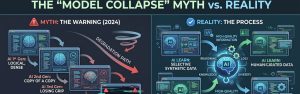
In 2026, we’ve found the solution: The AI Critic. Modern training pipelines use a “Generator-Critic” loop. One AI creates the synthetic data, while a second, highly specialized “Verifier AI” checks it for errors, hallucinations, or bias. Only the “perfect” data makes it into the final training set.

This curated, “High-Octane” synthetic data is actually better than human data because it’s free of the typos, slang, and logical fallacies that plague human-written text.
The Implications for 2026 and Beyond
- The Death of the “Public Web” Scraper
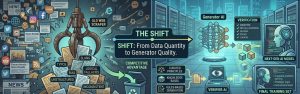
Companies are moving away from scraping the “messy” public web. Instead, they are building private, high-fidelity synthetic data factories. This has shifted the competitive advantage from who has the most data to who has the best synthetic generators.
- Specialized Industries (Health & Finance)
Synthetic data has been a godsend for restricted industries. Medical AI can now train on “synthetic patients”—statistically accurate digital clones that allow researchers to develop life-saving algorithms without ever seeing a real person’s private chart.

- The “Pure Logic” Era
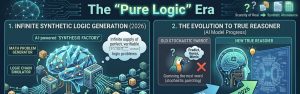
Because we can now “synthesize” math and logic problems at an infinite scale, AI has moved past being a “stochastic parrot” (just guessing the next word) and has become a true reasoner. By training on millions of synthetically generated logic chains, 2026 models can solve complex engineering problems that 2024 models couldn’t even understand.
The Bottom Line
The “Dirty Secret” isn’t actually that dirty—it’s a necessity. Without synthetic data, the AI revolution would have plateaued in 2025.
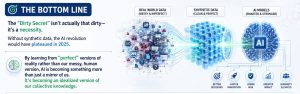
By learning from “perfect” versions of reality rather than our messy, human version, AI is becoming something more than just a mirror of us. It’s becoming an idealized version of our collective knowledge.