

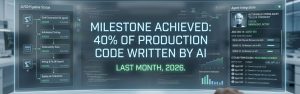
Last month, my team hit a milestone that seemed like science fiction just two years ago: 40% of the code currently running in our production environment was written, tested, and debugged by an AI.
We didn’t just use an “autocomplete” tool. We onboarded an Autonomous Coding Agent. In 2026, the distinction is vital. We are no longer “prompting” a chatbot; we are managing a silicon coworker that has its own Jira seat and its own GitHub permissions.
AI Coding Assistants Are Now Coworkers, Not Tools
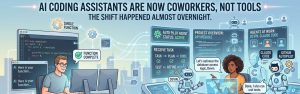
The shift happened almost overnight. In 2024, we were happy if an AI could finish a single function. By late 2025, tools like Devin, Claude Code, and GitHub’s Autopilot began operating as “agents.”
What is the difference?

- Tools (The Old Way): You write a comment, it suggests a line of code. You stay in the driver’s seat for every keystroke.
- Agents (The 2026 Reality): You assign a GitHub issue to the agent. It explores the entire codebase, creates a plan, spins up a virtual machine, writes the code, fixes its own test failures, and tags you only when the Pull Request (PR) is ready for a final human look.
Reality: Devin-Like Agents Fix Bugs and Review PRs

In our sprint last month, our AI “coworker” didn’t just handle the easy stuff. It took on tasks that used to drain our senior engineers’ time.
- The Self-Healing Pipeline
When our CI/CD pipeline broke at 3 AM due to a dependency conflict, I didn’t get a page. Our Devin-class agent automatically launched a session, diagnosed the version mismatch, updated the package.json, and ran a regression suite to ensure the fix didn’t break the frontend. By 9 AM, I just had to hit “Approve.”

- The “Sub-Agent” Orchestration
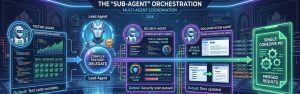
The most impressive part of the 2026 workflow is Multi-Agent Coordination. If I give a complex feature to my lead agent, it can now “delegate.”
- It spawns a Testing Agent to write 100% coverage suites.
- It spawns a Security Agent to run a static analysis (CodeQL) scan.
- It spawns a Documentation Agent to update our internal Wiki. They work in parallel, merging their results into a single, cohesive PR.
- PR Reviews as a Peer
AI agents are now performing the first pass on human code reviews. They don’t just check for style; they check for architectural consistency. If I try to introduce a pattern that goes against our AGENTS.md (the “rulebook” for our repository), the AI marks it as a “Request for Change” before my teammates even see it.

Does This Mean We Stop Coding?
Absolutely not. But our role has shifted. Last month, I spent:

- 20% of my time writing complex business logic the AI couldn’t grasp.
- 50% of my time on System Architecture and “Agent Orchestration”—designing how the pieces fit together.
- 30% of my time on Code Review and Strategic Oversight.
The “Senior Engineer” of 2026 is less of a “writer” and more of an “editor-in-chief.” We are moving away from manual labor and toward strategic problem decomposition.
The Bottom Line
If your team isn’t letting AI write at least a third of your code yet, you aren’t just slower—you’re at a competitive disadvantage. AI agents in 2026 have moved from “experimental” to “essential.”

They don’t get tired, they don’t miss edge cases in unit tests, and they never forget to update the documentation.
I didn’t lose my job to an AI; I gained a coworker who never sleeps.