Endpoint security is confusing. Every vendor uses different acronyms. EDR. MDR. XDR. NGAV. It is hard to know what you actually need.
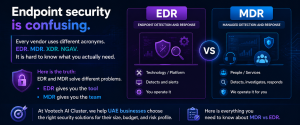
Here is the truth: EDR and MDR solve different problems.
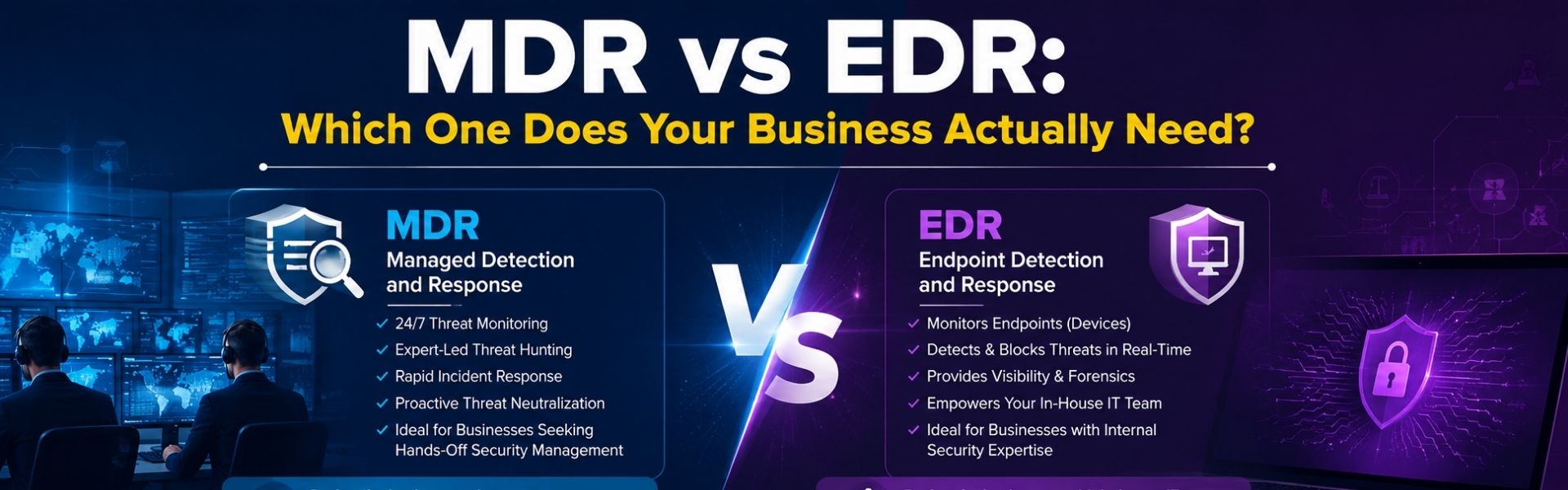
- EDR gives you the tool
- MDR gives you the team
At Vootech AI Cluster, we help UAE businesses choose the right security solutions for their size, budget, and risk profile.
Here is everything you need to know about MDR vs EDR.
What is EDR?
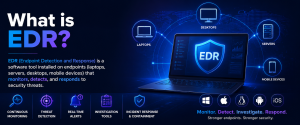
EDR (Endpoint Detection and Response) is a software tool installed on endpoints (laptops, servers, desktops, mobile devices) that monitors, detects, and responds to security threats.
What EDR does:
- Continuously records endpoint activity
- Detects malicious behavior using AI and rules
- Alerts security teams to potential threats
- Provides investigation tools for analysts
- Enables remote response (isolate, kill processes)
- Retains data for forensic analysis
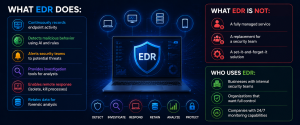
What EDR is NOT:
- A fully managed service
- A replacement for a security team
- A set-it-and-forget-it solution
Who uses EDR:
- Businesses with internal security teams
- Organizations that want full control
- Companies with 24/7 monitoring capabilities
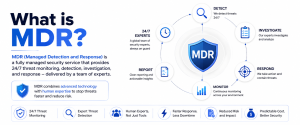
What is MDR?
MDR (Managed Detection and Response) is a fully managed security service that provides 24/7 threat monitoring, detection, investigation, and response – delivered by a team of experts.
What MDR includes:
- EDR technology (usually included in the service)
- 24/7 monitoring by security analysts
- Threat hunting and proactive detection
- Incident investigation and validation
- Remote response and containment
- Regular reporting and recommendations
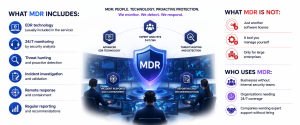
What MDR is NOT:
- Just another software license
- A tool you manage yourself
- Only for large enterprises
Who uses MDR:
- Businesses without internal security teams
- Organizations needing 24/7 coverage
- Companies wanting expert support without hiring

The simple way to remember:
- EDR gives you a fishing rod
- MDR gives you a fishing rod AND a professional fisherman 24/7
What EDR Does Well
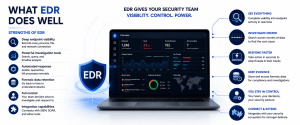
Strengths of EDR:
- Deep endpoint visibility – Records every process, file, and network connection
- Powerful investigation tools – Search, query, and timeline analysis
- Automated response – Isolate, quarantine, kill processes remotely
- Forensic data retention – Go back in time to understand attacks
- Full control – Your team decides what to investigate and respond to
- Integration capabilities – Connects with SIEM, SOAR, and other tools
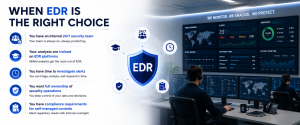
When EDR is the right choice:
- You have an internal 24/7 security team
- Your analysts are trained on EDR platforms
- You have time to investigate alerts
- You want full ownership of security operations
- You have compliance requirements for self-managed controls
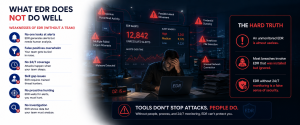
What EDR Does NOT Do Well
Weaknesses of EDR (without a team):
- No one looks at alerts – EDR generates alerts but needs human analysis
- False positives overwhelm – Your team gets buried in noise
- No 24/7 coverage – Attacks happen when your team sleeps
- Skill gap issues – EDR requires trained threat hunters
- No proactive hunting – EDR waits for alerts, you must hunt
- No investigation – EDR shows data but your team must analyze
The hard truth:
- An unmonitored EDR is almost useless
- Most breaches involve EDR that was installed but ignored
- EDR without 24/7 monitoring is a false sense of security

The Hidden Cost of EDR: Your Team
What EDR requires (that no one tells you):
People:
- 24/7 coverage needs 5-7 analysts for rotation
- Senior analyst to investigate complex threats
- Threat hunter for proactive searches
- Incident response lead for major events
Skills:
- EDR platform expertise (takes months to learn)
- Malware analysis and reverse engineering
- Network forensic investigation
- MITRE ATT&CK framework knowledge
Time:
- 1-2 hours daily just triaging alerts
- 4-8 hours per incident investigation
- 40+ hours monthly for reporting and tuning
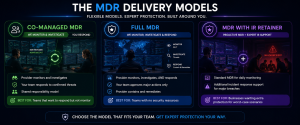
The MDR Delivery Models
Co-managed MDR:
- Provider monitors and investigates
- Your team responds to confirmed threats
- Shared responsibility model
- Best for: Teams that want to respond but not monitor
Full MDR:
- Provider monitors, investigates, AND responds
- Your team approves major actions only
- Provider contains and remediates
- Best for: Teams with no security resources
MDR with IR retainer:
- Standard MDR for daily monitoring
- Additional incident response support for major breaches
- Best for: Businesses wanting extra protection for worst-case scenarios
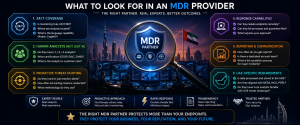
What to Look for in an MDR Provider
Must-have features:
24/7 coverage:
- Is monitoring truly 24/7/365?
- Where are analysts located?
- What is the language capability (Arabic, English)?
Human analysts (not just AI):
- Do they have L1, L2, L3 analysts?
- What certifications (CISSP, GIAC, SANS)?
- What is the analyst-to-customer ratio?
Proactive threat hunting:
- Do they hunt or just monitor alerts?
- How often are hunting missions conducted?
- What methodology do they use?
Response capabilities:
- Can they isolate endpoints remotely?
- Can they kill processes and quarantine files?
- What requires your approval?
Reporting and communication:
- How often do you get reports?
- Is there a dedicated account team?
- What is the escalation process for major incidents?
UAE-specific requirements:
- Is data processed and stored in the UAE?
- Are they aligned with NESA, NCA, PDPL?
- Do they have local analysts familiar with UAE threat landscape?
Real-World Scenarios: EDR vs MDR
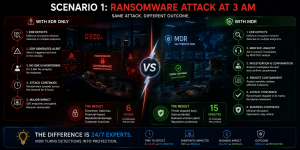
Scenario 1: Ransomware attack at 3 AM
With EDR only:
- EDR detects malicious encryption behavior
- EDR generates an alert
- No one is monitoring at 3 AM
- Attack continues for 6 hours until team arrives
- 500 endpoints encrypted, ransom demanded
With MDR:
- EDR detects malicious encryption behavior
- MDR SOC analyst receives alert immediately
- Analyst investigates and confirms ransomware
- Analyst remotely isolates affected endpoints
- Attack contained within 15 minutes
- Business continues with minimal disruption
Scenario 2: Phishing email leads to credential theft
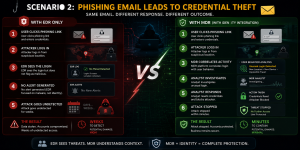
With EDR only:
- User clicks phishing link and enters credentials
- Attacker logs in from suspicious location
- EDR sees the login but does not flag as malicious
- No alert generated (EDR focused on malware, not identity)
- Attack goes undetected for weeks
With MDR (with identity integration):
- User clicks phishing link and enters credentials
- Attacker logs in from suspicious location
- MDR platform correlates login with user behavior
- Analyst investigates unusual login
- Analyst resets credentials and blocks attacker
- Attack stopped within minutes
EDR vs MDR vs XDR vs NGAV
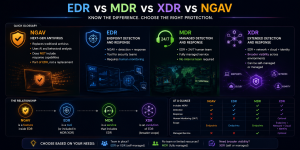
Quick glossary:
NGAV (Next-Gen Antivirus):
- Replaces traditional antivirus
- Uses AI and behavioral analysis
- Does NOT include response capabilities
- Part of EDR, not a replacement
EDR (Endpoint Detection and Response):
- NGAV + detection + response
- Tool for security teams
- Requires human monitoring
MDR (Managed Detection and Response):
- EDR + 24/7 human team
- Fully managed service
- No internal team required
XDR (Extended Detection and Response):
- EDR + network + cloud + identity
- Broader visibility across environments
- Can be self-managed or managed
The relationship:
- NGAV is a feature inside EDR
- EDR is a tool (or included in MDR/XDR)
- MDR is a service that includes EDR
- XDR is an evolution of EDR (broader scope)
How Vootech AI Cluster Helps with MDR and EDR
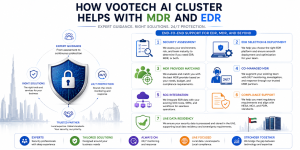
Vootech AI Cluster provides endpoint security solutions including:
- Security assessment – Determine if you need EDR, MDR, or both
- EDR selection and deployment – Choose the right tool for your team
- MDR provider matching – Find the right managed service for your needs
- Co-managed MDR – Augment your existing team with 24/7 monitoring
- SOC integration – Connect EDR to your existing SOC tools
- Compliance support – Ensure NESA, NCA, PDPL alignment
- UAE data residency – Keep your security data in the UAE
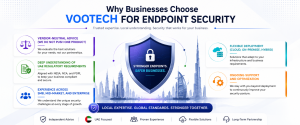
Why businesses choose Vootech for endpoint security:
- Vendor-neutral advice (we do not push one product)
- Deep understanding of UAE regulatory requirements
- Experience across SMB, mid-market, and enterprise
- Flexible deployment (cloud, on-premise, hybrid)
- Ongoing support and optimization
Quick Decision Guide
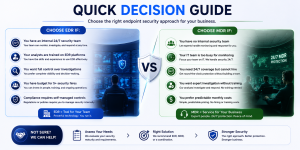
Choose EDR if:
- You have an internal 24/7 security team
- Your analysts are trained on EDR platforms
- You want full control over investigations
- You have budget for 5+ security hires
- Compliance requires self-managed controls
Choose MDR if:
- You have no internal security team
- Your IT team is too busy for monitoring
- You need 24/7 coverage but cannot hire
- You want expert investigation without training
- You prefer predictable monthly costs
Ready to Secure Your Endpoints?
EDR gives you the tool. MDR gives you the team. Most UAE businesses do not have the resources for 24/7 EDR monitoring. That is why MDR is the right choice for most mid-market organizations.
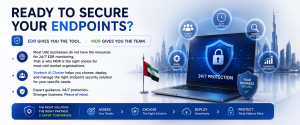
Vootech AI Cluster helps you choose, deploy, and manage the right endpoint security solution for your specific needs.