
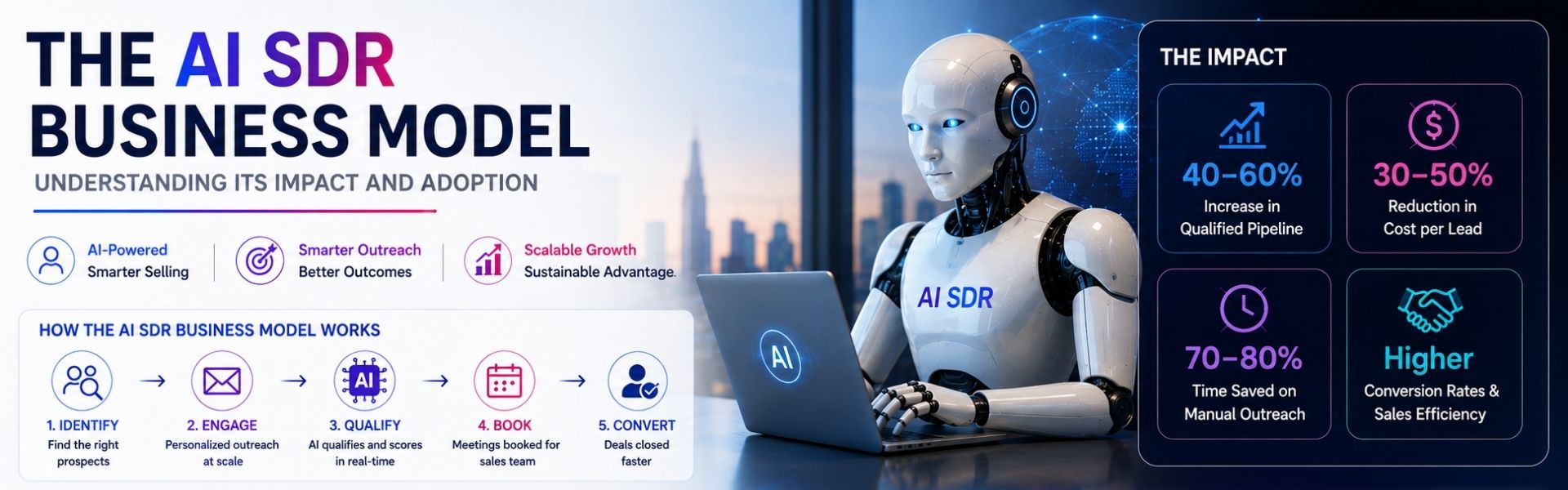
Sales development has always revolved around reaching as many prospects as possible to build a robust pipeline.
However, traditional human Sales Development Representatives (SDRs) come with challenges: they are costly, slow to scale, and often inconsistent. Fortunately, the landscape is changing rapidly.
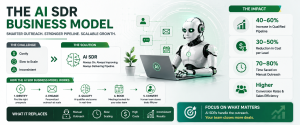
The AI SDR business model is gaining popularity among mid-market B2B companies because it effectively addresses these limitations.
This guide will explain how the AI SDR business model operates, what it replaces, and how businesses can implement it to create genuine pipeline opportunities rather than just automated noise.
What Is an AI SDR?
A traditional SDR focuses on the early stages of the sales cycle, which includes identifying prospects, sending outreach messages, following up, and booking qualified meetings for account executives. This role is repetitive and requires consistency over creativity.
In contrast, an AI SDR is a software agent that autonomously performs these same functions. It can:
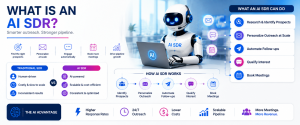
- Research and identify prospects that align with your Ideal Customer Profile (ICP)
- Personalize outreach emails at scale using data signals
- Automatically send and sequence follow-up messages
- Handle initial responses and qualify interest
- Book meetings directly into a representative’s calendar
The key difference from basic email automation lies in the intelligence layer. AI SDRs leverage large language models to craft context-aware messages, adjust tone based on prospect signals, and respond to replies, moving beyond mere pre-written templates.
How the AI SDR Business Model Works
The AI SDR business model is built on a straightforward principle: replace high-cost, low-leverage human activities with AI agents that can operate at scale, around the clock, without fatigue or quota anxiety.
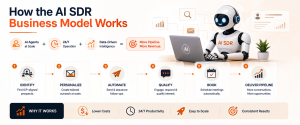
Here’s how the model typically functions:
- Lead Sourcing and Enrichment: The AI agent sources prospects from databases like LinkedIn, Apollo, and ZoomInfo, enriching profiles with firmographic and intent data to identify contacts that match your ICP.
- Personalized Outreach at Scale: Instead of sending generic cold emails, the AI SDR generates tailored messages for each prospect, referencing their role, company size, recent news, or product signals—instantly across hundreds or thousands of contacts.
- Automated Sequencing and Follow-Up: The agent manages multi-step outreach sequences, adjusting timing based on engagement signals like opens and clicks.
- Response Handling and Qualification: When a prospect replies, the AI SDR can qualify the response, answer common questions, and route interested leads to a human representative for the next steps.
- Meeting Booking: Qualified prospects can book directly through integrated calendar links, streamlining the process and reducing delays in pipeline generation.
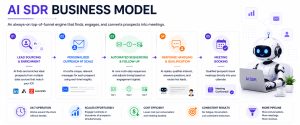
The outcome is a top-of-funnel engine that operates continuously without the overhead of a full SDR team.
Why Businesses Are Shifting to This Model
The economics are clear. A single human SDR costs over $4,500 per month in the U.S., plus additional expenses for tools and management. In contrast, an AI SDR agent like AiSDR costs around $900 per month for 1,200 messages, bringing the cost per email to under $1.
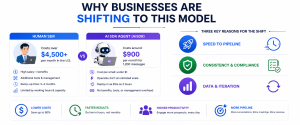
Beyond cost, three key factors drive this shift:
- Speed to Pipeline: Human SDR teams take 3-4 months to ramp up, while AI SDRs can be deployed in as little as 2 hours and operate 24/7 without time-zone limitations.
- Consistency and Compliance: Every message adheres to the same structure, brand voice, and compliance requirements, unaffected by individual performance fluctuations.
- Data and Iteration: AI SDRs provide detailed engagement data on outreach efforts, creating a feedback loop that continuously enhances messaging quality.
Real-World Results
A Fortune 500 company utilizing AiSDR sent around 8,000 emails over 4.5 months, achieving:
- A 1.67% positive reply rate on cold multi-touch campaigns
- A 6.19% positive reply rate on event-based campaigns
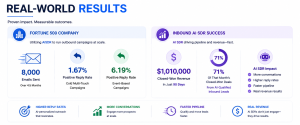
In another instance, an inbound AI SDR generated $1,010,000 in closed-won revenue in just 90 days, with 71% of that month’s closed-won deals coming from AI-qualified inbound leads.
What the AI SDR Model Does Not Replace
It’s important to clarify the limitations of the AI SDR model. While it excels at prospecting, outreach, and initial qualification, it does not replace:
- Complex discovery conversations requiring human judgment
- Relationship-driven enterprise sales where personal connections are crucial
- Strategic account planning and multi-stakeholder navigation
- Negotiation and deal closing
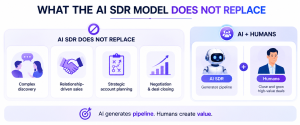
The model is most effective when human representatives are freed from high-volume, low-complexity tasks, allowing them to focus on areas where human judgment adds real value. AI manages pipeline generation, while humans handle pipeline conversion.
Who AI SDRs Are Best For
AI SDRs are not a universal solution. The most effective AI SDR companies often disqualify more prospects than they qualify.
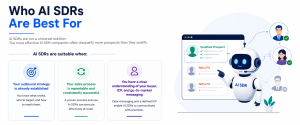
AI SDRs are suitable when:
- Your outbound strategy is already established
- Your sales process is repeatable and consistently successful
- You have a clear understanding of your buyer, ICP, and go-to-market messaging
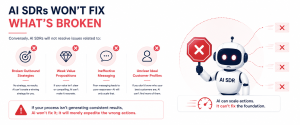
Conversely, AI SDRs will not resolve issues related to:
- Broken outbound strategies
- Weak value propositions
- Ineffective messaging
- Unclear ideal customer profiles
If your process isn’t generating consistent results, AI won’t fix it; it will merely expedite the wrong actions.
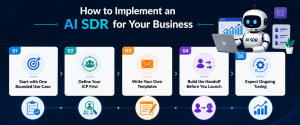
How to Implement an AI SDR for Your Business
Successfully integrating an AI SDR requires more than just activating a tool. The quality of its output heavily relies on configuration, integration, and ongoing management. As SaaStr’s Jason Lemkin notes, “You can turn it on in an afternoon. That’s very different from having it work.”
- Start with One Bounded Use Case: Avoid trying to replace your entire SDR function immediately. Begin with one specific use case, such as inbound follow-up or CRM reactivation.
- Define Your ICP First: AI SDRs amplify your targeting efforts. Clear targeting leads to better customer acquisition, while vague targeting can damage your domain reputation.
- Write Your Own Templates: Don’t rely on vendor templates. Create your own, keeping them concise—emails that secure meetings are often under 75 words.
- Build the Handoff Before You Launch: Clearly define what responses the AI will handle, what triggers a human handoff, and establish response time expectations.
- Expect Ongoing Tuning: AI SDRs require continuous adjustment. Allocate time for refining your ICP and messaging, and expect to spend 30-45 minutes daily for the first 60-90 days.
The VooTech Verdict
The AI SDR business model is not a substitute for effective selling; it represents a fundamental shift in how top-of-funnel activities are managed. Companies relying solely on human SDR teams for prospecting and outreach face unnecessary costs and slower pipeline velocity compared to those automating these functions.
When implemented correctly—with a sharp ICP, well-configured messaging, clean integrations, and ongoing performance management—the AI SDR model can significantly enhance your sales efforts. VooTech’s AI consulting can make the difference between a tool that remains idle and one that actively fills your calendar.
The AI SDR landscape is evolving rapidly. While 88% of AI pilots stall before delivering value, high-performing teams are successfully deploying AI SDRs for inbound lead follow-up, nurturing, and customer service—anywhere speed and consistency are essential.
Ready to scale your pipeline without increasing headcount? VooTech is here to help B2B businesses navigate the complexities of AI sales automation. Contact us to begin your AI SDR implementation journey today.