
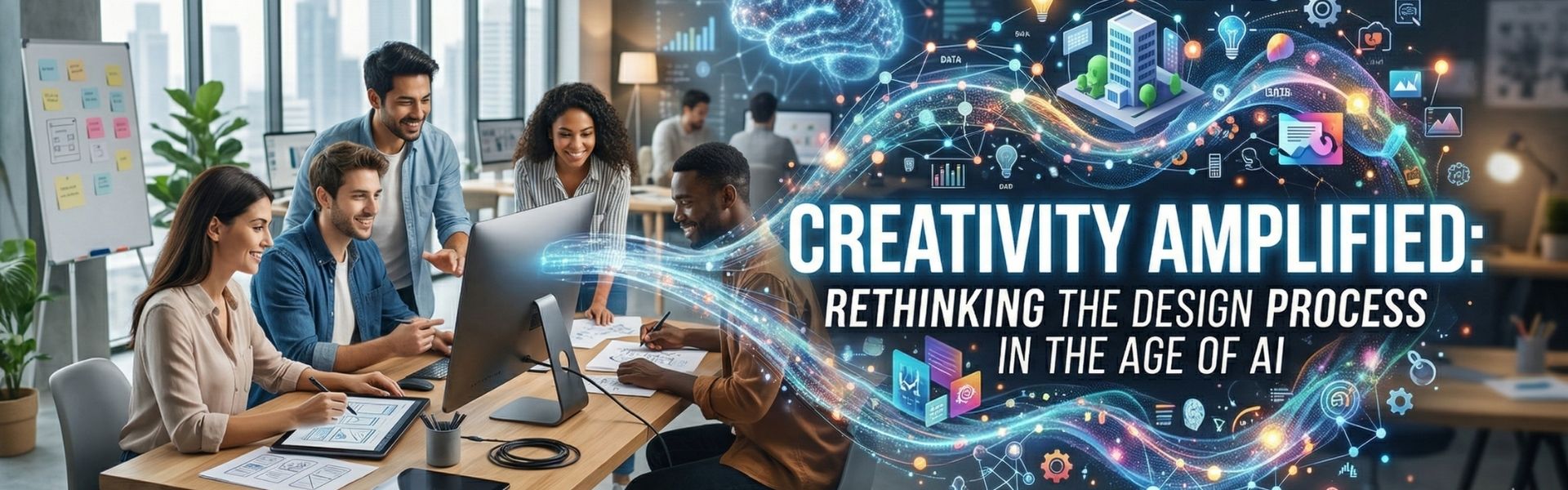
Design is going through a quiet revolution. It’s not just about faster software or smarter tools—it’s about how human creativity and artificial intelligence now work together.
For decades, the design process stayed the same: research, brainstorm, prototype, and refine. Designers relied mainly on their own ideas and skills. Today, that model is changing. In the age of AI, creativity is becoming a collaboration between human intuition and machine intelligence.

AI doesn’t replace designers—it amplifies their abilities. Research shows that designers who work effectively with AI often produce ideas that are more complete, innovative, and practical. But using AI successfully requires rethinking how the entire design process works.
A New Role for Designers
The designer’s role is shifting from creator to curator. Instead of starting from a blank page, designers explore ideas generated with AI, then select, refine, and shape the best ones.

To thrive in this new environment, designers need new skills such as:
- Prompt literacy – communicating ideas clearly to AI tools
- Critical curation – selecting the best outputs
- Iterative refinement – guiding AI results toward a vision
- Concept integration – turning ideas into cohesive designs
- Ethical judgment – maintaining authorship and responsibility

Human–AI Co-Creation
A new approach called the Human-AI Co-Creative Design Process combines traditional design thinking with AI collaboration.
AI helps in different stages of design:
- Discover: analyze research and identify patterns
- Define: understand user needs and frame problems
- Develop: generate new design concepts and variations
- Deliver: assist with prototyping and refinement
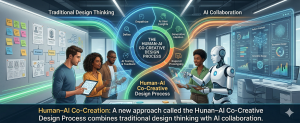
The most successful designers treat AI as a collaborative partner, not just a command-based tool.
Real-World Examples
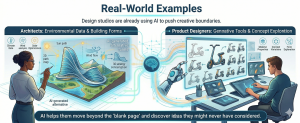
Design studios are already using AI to push creative boundaries. Architects use AI to model environmental data and generate building forms. Product designers use generative tools to explore shapes, materials, and concepts much faster than before. AI helps them move beyond the “blank page” and discover ideas they might never have considered.
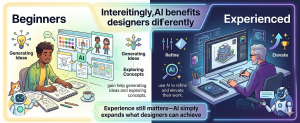
Interestingly, AI benefits designers differently:
- Beginners gain help generating ideas and exploring concepts.
- Experienced designers use AI to refine and elevate their work.
Experience still matters—AI simply expands what designers can achieve.
The Future of Design
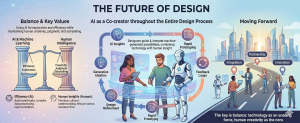
As AI continues to evolve, it will become a co-creator throughout the entire design process. Designers will guide and interpret machine-generated possibilities, combining technology with human insight.
The key is balance: using AI for exploration and efficiency while maintaining human creativity, judgment, and storytelling.
The Bottom Line
AI is not replacing creativity—it’s expanding it.
Designers who embrace this partnership will move faster, explore more possibilities, and create work that neither humans nor machines could achieve alone.
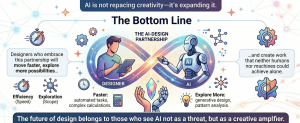
The future of design belongs to those who see AI not as a threat, but as a creative amplifier.