
For years, AI agents have been stuck in isolated environments, unable to communicate with one another.
A Claude agent couldn’t interact with a Salesforce agent, and a Google agent couldn’t connect with tools designed for OpenAI. Each integration was unique, creating a fragmented landscape reminiscent of the early internet, where custom gateways were needed for communication.
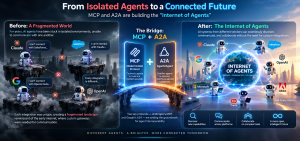
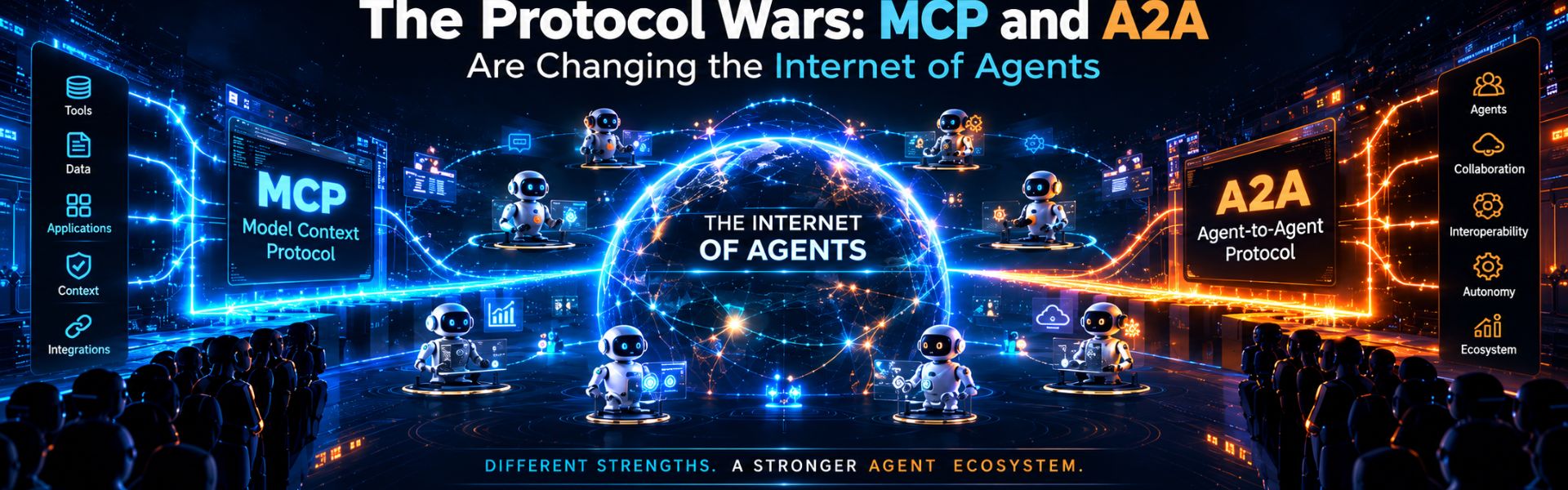
However, this is changing quickly. Two key protocols—Anthropic’s Model Context Protocol (MCP) and Google’s Agent2Agent (A2A)—are setting the groundwork for agent interoperability. Together, they are paving the way for what many are calling the “Internet of Agents,” a realm where AI systems from different vendors can seamlessly discover, communicate, and collaborate without the need for custom integrations.
The M×N Integration Nightmare
Before these protocols, connecting AI models to external tools required a unique integration for every combination. If you had five AI applications and ten tools, you could need up to fifty custom connectors. Each connector was a maintenance headache—fragile, undocumented, and hard to scale.
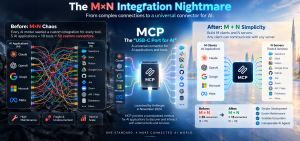
This is the classic M×N integration problem. MCP addresses this by simplifying the process. Instead of creating M times N custom connectors, developers only need to build M clients and N servers. Any client can communicate with any server, transforming the math from multiplication to addition.
Launched by Anthropic in November 2024, MCP offers a standardized method for AI applications to discover and interact with external tools and services. Think of it as the “USB-C port for AI”—a universal connector that allows any compliant AI system to connect with any compliant tool.
MCP: The Vertical Protocol
MCP tackles a vertical challenge: enabling one agent to access the systems it needs. It operates on a client-server architecture using JSON-RPC, where an MCP server provides a defined set of tools and resources that any compliant client can use.
The protocol consists of three main components:
- MCP Host: The AI application (like Claude) that manages connections.
- MCP Client: The component that connects to a server.
- MCP Server: The program that offers tools and resources to clients.
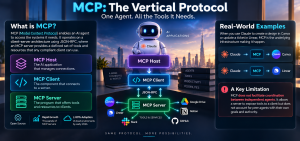
When you use Claude to create a design in Canva or update a ticket in Linear, MCP is the underlying infrastructure making it happen. Its open-source nature has led to a rapid increase in MCP servers, with at least 80% of cloud environments adopting it by early 2026.
However, MCP does not facilitate coordination between independent agents. It allows a server to expose tools to a client but does not account for peer agents with their own goals and authority.
A2A: The Horizontal Protocol
This is where Google’s Agent2Agent protocol comes into play. Introduced in April 2025, A2A focuses on enabling agents to discover one another, exchange messages, and coordinate tasks across different platforms.
The distinction is crucial. As one analysis states: “MCP answers ‘how does one agent reach the systems it needs.’ A2A answers ‘how do two agents that don’t share a codebase work together.'”
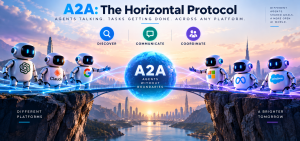
A2A’s architecture supports a peer-to-peer model. Each agent publishes an Agent Card—a JSON metadata file that describes its capabilities, authentication methods, and communication modes. Other agents can access this card to determine what tasks to delegate, similar to how OpenAPI specs describe REST APIs.
Communication occurs over JSON-RPC 2.0, with support for streaming responses and push notifications. Each interaction is encapsulated in a Task that transitions through defined states: submitted, working, completed, or failed. This structure allows agents to manage both quick queries and long-running workflows.
The key insight is that neither agent needs to understand the other’s implementation. A Python agent doesn’t need to run Go code, and vice versa; they simply communicate using a shared protocol over HTTP.
The Layered Architecture
It’s essential to recognize that MCP and A2A are not competing standards; they operate at different layers of the agentic stack.
Consider a typical enterprise workflow:
- A user submits an onboarding request to an Orchestrator Agent.
- The Orchestrator sends an A2A SendMessage call to a KYC Agent for identity verification.
- The KYC Agent uses MCP servers internally for credit-check APIs and ID verification.
- The KYC Agent synthesizes results and returns them to the Orchestrator via A2A.
- The Orchestrator delivers the final response to the user.
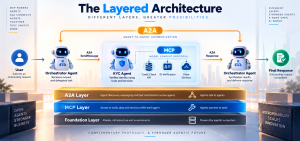
In this scenario, the Orchestrator uses A2A to delegate tasks, while the KYC Agent utilizes both A2A and MCP. Neither needs to know the other’s internal workings.
This layered approach is why researchers at Zenodo describe MCP and A2A as “complementary rather than competing,” estimating that a unified approach can reduce integration complexity by 60–70% compared to ad-hoc solutions.
Governance and Enterprise Adoption
Both protocols have quickly moved toward neutral governance. MCP was donated to the Agentic AI Foundation under the Linux Foundation in December 2025, making it vendor-neutral. A2A joined the same foundation in 2025, and by April 2026, the Linux Foundation reported active deployments across various sectors, including supply chain and financial services.
A2A’s launch partners include major players like Amazon Web Services, Cisco, Google, Microsoft, Salesforce, SAP, and ServiceNow. Today, A2A is integrated into platforms like Microsoft Azure AI Foundry and AWS Bedrock AgentCore.
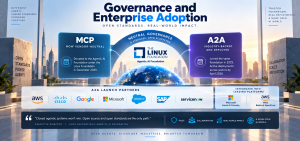
The governance aspect is crucial as it indicates stability. As the executive director of the Linux Foundation’s Agentic AI Foundation stated: “Closed agentic systems won’t win. Open source and open standards are the only path.”
The Security Surface
Both protocols introduce new security challenges that enterprises must address. MCP’s flexibility allows agents to discover and invoke tools dynamically, which can lead to risks such as malicious tool descriptions and prompt injection.
Research on over 500 MCP servers found that 38% lacked authentication, meaning any client could invoke its tools. While the protocol standardizes discovery and invocation, it largely leaves authentication and authorization to the implementers.
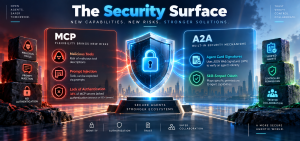
A2A enhances security through Agent Card signatures using JSON Web Signatures (JWS). Clients verify that a card originates from the claimed domain before trusting the agent. The protocol also supports skill-scoped OAuth, mapping specific permissions to agent capabilities.
The Path Forward
The “Internet of Agents” is still in development. MCP currently has a larger ecosystem, with over 13,000 active remote endpoints and broad adoption across major AI players. A2A is earlier in its adoption but benefits from strong enterprise support and governance.
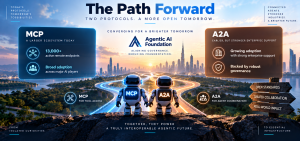
Both protocols are converging under the Agentic AI Foundation, with governance structures aligning to minimize fragmentation. For developers and enterprises, the implication is clear: serious agent deployments will utilize both MCP for tool access and A2A for agent coordination. Together, they lay the groundwork for a truly interoperable agentic future, transforming agents from isolated curiosities into essential infrastructure.