
For years, digital marketing has revolved around a straightforward principle: rank on page one, attract clicks, and drive traffic. We focused heavily on keyword density, backlink profiles, and domain authority. However, if you’ve noticed changes in your organic traffic or seen your content featured as a “Featured Snippet” above the first search result, you’ve experienced a significant shift in how the internet operates.
Welcome to the era of AEO (Answer Engine Optimization). At Vootech, we believe it’s time to stop questioning whether SEO is dead. Instead, we should explore how it has evolved. Let’s break down the differences between the SEO we’ve mastered and the AEO future we’re heading toward.
What is SEO? (The Foundation)
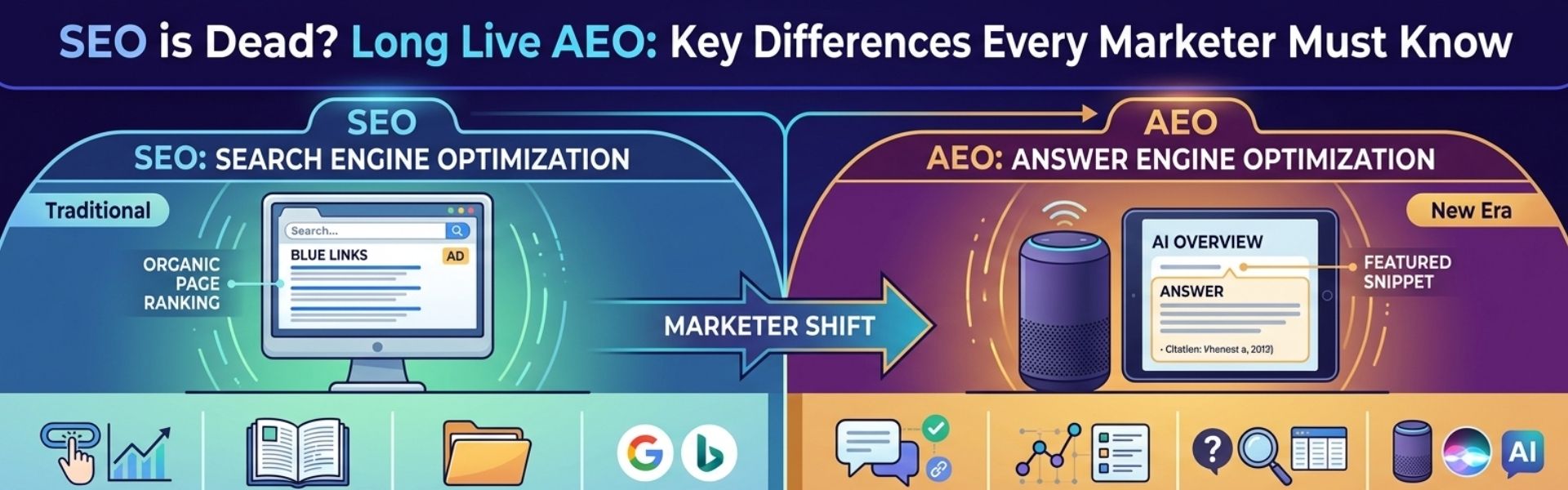
SEO (Search Engine Optimization) is all about visibility. It involves optimizing your website so that search engines like Google can understand your content, ultimately leading to higher rankings for specific keywords.
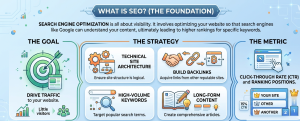
- The Goal: Drive traffic to your website.
- The Strategy: Focus on high-volume keywords, build backlinks, ensure technical site architecture, and create long-form content.
- The Metric: Click-Through Rate (CTR) and ranking positions.
What is AEO? (The Evolution)
AEO (Answer Engine Optimization) shifts the focus to authority and intent. In the age of AI-powered search (like ChatGPT, Gemini, and Google’s AI Overviews), users are no longer satisfied with a list of ten blue links; they want immediate answers.
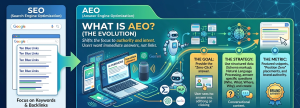
AEO optimizes content so that AI models and voice assistants can extract concise, accurate answers from your site.
- The Goal: Provide the “Zero-Click” answer.
- The Strategy: Use structured data (Schema markup), natural language processing, answer specific questions (Who, What, Where, Why), and create conversational content.
- The Metric: Featured snippets, “Position Zero” placements, and brand authority.
Key Differences at a Glance: SEO vs. AEO
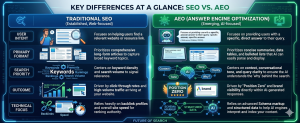
- User Intent
- Traditional SEO: Focuses on helping users find a relevant website or resource link.
- AEO: Focuses on providing users with a specific, direct answer to their query.
- Primary Format
- Traditional SEO: Prioritizes comprehensive long-form articles to capture broad keyword topics.
- AEO: Prioritizes concise summaries, data tables, and bulleted lists that AI can easily parse and display.
- Search Priority
- Traditional SEO: Centers on keyword density and search volume to signal relevance.
- AEO: Centers on context, conversational tone, and query clarity to ensure the AI understands the “why” behind the search.
- Outcome
- Traditional SEO: Driven by click-through rates and high-volume traffic arriving at your website.
- AEO: Driven by “Position Zero” and brand visibility directly within AI-generated responses.
- Technical Focus
- Traditional SEO: Relies heavily on backlink profiles and overall site speed for ranking authority.
- AEO: Relies on advanced Schema markup and structured data to help AI engines interpret and index your content.
Why AEO is the Future
The internet is evolving to be faster and more efficient. When a user asks a smart speaker, “How do I fix a leaky faucet?” they want immediate steps, not a link to a blog post. AEO prioritizes user experience. If your brand provides the answer, you become the go-to source of truth. Even in a “Zero-Click” world, users learn to trust brands that solve their problems instantly. When they need a deeper dive or professional service, they will return to the brand that demonstrated expertise through an AI-delivered answer.
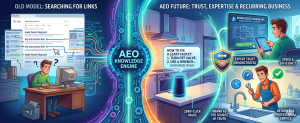
It’s Not a Replacement; It’s an Evolution
Many marketers worry that AEO will cannibalize their traffic. However, consider this: you’re not losing traffic; you’re gaining visibility where your customers actually engage. AEO doesn’t render SEO obsolete. To succeed in AEO, you still need:
- A technically sound website (SEO foundation).
- High-quality content (SEO content strategy).
- Backlinks (to establish authority worthy of being quoted by AI).
At Vootech, we see this as a refinement of our craft. We’re moving away from “writing for robots” to “optimizing for clarity.”
The Takeaway for Marketers
Don’t abandon your SEO strategy—evolve it. Start structuring your content to answer questions directly, use clear headings, implement schema markup, and embrace conversational language.
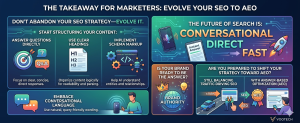
The future of search is conversational, direct, and fast. Is your brand ready to be the answer? Are you prepared to shift your strategy toward AEO, or are you still balancing traffic-driving SEO with answer-based optimization?