Archives November 2025

Pay-Per-Click Advertising (PPC): Getting Started With Google Ads

Hand drawing PPC elements with doodles of money icons, mouse clicks, arrows, rocket, gears, and digital marketing symbols

Introduction: What Is Pay-Per-Click (PPC) Advertising?

In today’s digital landscape, getting your business in front of potential customers at the right moment is crucial. Pay-Per-Click (PPC) advertising offers a powerful solution, allowing you to display ads to users precisely when they’re searching for products or services like yours.

Understanding how PPC works is straightforward: you create and place ads on platforms like Google, and you only pay when someone actually clicks on them. It’s an auction-based system where advertisers bid for ad placement in search results and on websites across the internet.

Illustration showing a user clicking an online ad and how payment works in PPC

PPC lets businesses pay only when someone clicks their ads — fast, measurable, and effective.

Why businesses use Google Ads to grow faster comes down to immediacy and precision. Unlike organic methods that take months to show results, PPC can drive targeted traffic to your website from day one. Whether you’re launching a new product, promoting a special offer, or looking to scale your business quickly, Google Ads provides the tools to reach ready-to-buy customers instantly.

  1. How Google Ads Works

To succeed with PPC, you need to understand the fundamental mechanics behind Google’s advertising system.

The basics of bidding, ad rank, and quality score form the core of how ads compete:

  • Bidding: You set the maximum amount you’re willing to pay for a click
  • Ad Rank: This determines your ad position and is calculated using your bid × Quality Score
  • Quality Score: Google’s rating of your ad quality and relevance (based on CTR, ad relevance, and landing page experience)
Illustration explaining Google Ads bidding system and quality score components

A simple breakdown of how Google Ads determines which ads appear first.

Difference between search, display, shopping, and video ads:

  • Search Ads: Text ads that appear in Google search results when people search for your keywords
  • Display Ads: Visual banner ads that appear on websites within Google’s network
  • Shopping Ads: Product-based ads showing images, prices, and store names
  • Video Ads: Commercials that play before, during, or after YouTube videos
Overview of Google Ads formats including search ads, display ads, shopping ads, and video ads

A quick comparison of Google Ads formats to help advertisers choose the right one.

  1. Benefits of PPC Advertising

PPC offers unique advantages that make it an essential component of modern marketing strategies.

Immediate visibility and traffic: While SEO can take months to generate traffic, PPC can put you at the top of search results within hours of launching your campaign. This makes it ideal for time-sensitive promotions or new market entries.

Full control over budget and targeting: You decide exactly how much to spend daily and which audiences see your ads. Advanced targeting options let you reach users by location, demographics, interests, and even specific times of day.

Data-driven results and easy tracking: Every dollar spent is measurable. You can track conversions, phone calls, form submissions, and revenue, giving you clear insights into your return on investment.

Infographic showing PPC benefits like traffic boost, budget control, and data tracking

PPC delivers instant visibility, complete budget control, and powerful data insights.

  1. Setting Up Your First Google Ads Campaign

Launching your first campaign doesn’t need to be complicated. Follow this structured approach:

Step-by-step process to create an account:

  1. Visit ads.google.com and click “Start Now”
  2. Choose your campaign goal (Sales, Leads, or Website Traffic)
  3. Select your campaign type (Search, Display, Shopping, or Video)
  4. Set your budget and bidding strategy
  5. Define your target audience and location
  6. Create your ad groups and write your ads
Illustration of a person launching their first Google Ads campaign on a computer

A beginner-friendly visual for creating and launching your first Google Ads campaign.

Choosing your campaign type and goals depends on your objectives:

  • For direct sales: Search Network with Shopping ads
  • For brand awareness: Display or Video campaigns
  • For lead generation: Search Network with lead form extensions
Google Ads campaign objectives for lead generation, direct sales, and brand awareness

Pick the right campaign type based on whether you want leads, sales, or brand visibility.

  1. Keyword Research for PPC Success

Your keyword strategy determines who sees your ads and how much you pay for clicks.

Illustration of a magnifying glass character and a search bar representing keyword research

Good keyword research is the foundation of every profitable PPC campaign.

How to find profitable keywords:

  • Use Google’s Keyword Planner to discover search volume and competition
  • Analyze competitor keywords using tools like SEMrush or Ahrefs
  • Brainstorm from your customer’s perspective – what would they search for?
  • Focus on commercial intent keywords (e.g., “buy,” “price,” “near me”)
Infographic showing broad match, phrase match, exact match, and negative keyword icons

Match types control who sees your ads — and how relevant your traffic is.

Match types: broad, phrase, exact, and negative keywords:

  • Broad Match: Reaches widest audience but may include irrelevant searches
  • Phrase Match: Shows your ad for searches that include your exact phrase
  • Exact Match: Targets searches that match your term exactly or close variations
  • Negative Keywords: Prevents your ads from showing for irrelevant searches
  1. Crafting High-Performing Ad Copy
Illustration of marketers creating high-quality ad copy on a computer screen

Strong copy boosts clicks, conversions, and overall campaign success.

Great ad copy can double or triple your click-through rates while lowering your costs.

Writing compelling headlines and descriptions:

  • Include your primary keyword in at least one headline
  • Use numbers and power words (“Free,” “Now,” “Proven”)
  • Highlight unique selling propositions and benefits
  • Create a sense of urgency when appropriate
Illustration of a person crafting ad headlines and descriptions on a digital interface

Great PPC ads start with strong headlines and clear, persuasive descriptions.

Using emotional triggers and clear CTAs:

  • Address pain points and offer solutions
  • Incorporate emotional triggers like “Relief,” “Success,” or “Security”
  • Include clear, action-oriented CTAs (“Buy Now,” “Get Quote,” “Learn More”)
  • Use ad extensions to provide additional information and links
Illustration showing emotions and a “Buy Now” CTA to represent persuasive advertising

Emotions drive action. Clear CTAs drive conversions.

  1. Understanding Bidding Strategies and Budgeting

Smart bidding and budgeting are essential for maximizing your advertising ROI.

Manual vs. automated bidding:

  • Manual Bidding: Full control over your maximum CPC bids
  • Automated Bidding: Google’s AI optimizes bids toward your goals (conversions, clicks, or impressions)
  • Recommended for beginners: Start with Maximize Clicks or Target CPA
Illustration comparing manual bidding by a marketer and automated bidding by an AI robot

Manual gives control. Automated gives efficiency. Choose the bidding style that suits your goals.

How to optimize spend for maximum ROI:

  • Start with a conservative daily budget and scale up as you see results
  • Allocate more budget to high-performing keywords and ad groups
  • Use dayparting to show ads during your most profitable hours
  • Regularly review and adjust bids based on performance data
Illustration of a marketer analyzing charts and graphs to optimize PPC spending

Smart budgeting and data-driven decisions lead to higher ROI in your PPC campaigns.

  1. Designing Effective Landing Pages

Your landing page is where clicks turn into conversions – don’t waste expensive traffic on poor user experiences.

Illustration of a relevant landing page with check marks indicating good user experience

Relevant content + smooth UX = higher Quality Score and better conversions.

Importance of relevance and user experience:

  • Ensure your landing page directly relates to your ad copy and keywords
  • Create a seamless journey from ad click to conversion
  • Optimize for mobile devices (over 60% of searches happen on mobile)
  • Build trust with security badges, testimonials, and contact information
Landing page illustration showing conversion arrows, a “Buy Now” button, and performance indicators

A stronger landing page = higher conversions and fewer bounced visitors.

Tips for improving conversions and lowering bounce rates:

  • Use clear, compelling headlines that match your ad message
  • Include prominent, action-oriented call-to-action buttons
  • Remove unnecessary navigation that might distract from converting
  • Test different layouts, offers, and form lengths
  1. Tracking, Measuring, and Optimizing Campaigns

What gets measured gets improved. Proper tracking transforms random spending into strategic investment.

Using Google Analytics and conversion tracking:

  • Install the Google Ads conversion tracking tag on your website
  • Link your Google Analytics and Google Ads accounts
  • Set up goals to track valuable actions (purchases, form submissions, calls)
  • Use UTM parameters to track campaign performance in Analytics
Illustration of Google Analytics dashboard showing charts and metrics

Monitoring your data is the key to improving campaign results.

Key metrics: CTR, CPC, Quality Score, and ROAS:

  • CTR (Click-Through Rate): Percentage of people who click your ad after seeing it
  • CPC (Cost-Per-Click): Average amount you pay for each click
  • Quality Score: Google’s rating of your ad quality and relevance
  • ROAS (Return on Ad Spend): Revenue generated for every dollar spent
Illustration of CTR, CPC, Quality Score, and ROAS with charts and icons

Your four must-track PPC performance indicators: CTR, CPC, Quality Score, and ROAS.

  1. Common PPC Mistakes and How to Avoid Them
Infographic showing PPC mistakes like broad targeting and ignoring A/B testing

Avoid wasted spend by fixing these two common PPC pitfalls.

Learning from others’ mistakes can save you thousands of dollars and months of frustration.

Wasting money on broad targeting:

  • Start with exact and phrase match keywords before testing broad match.
  • Use negative keywords aggressively to filter out irrelevant traffic.
  • Segment your campaigns by theme rather than using one giant campaign.
Illustration showing wasted money, broad targeting symbol, segmented campaigns, and keyword match types

Stop letting your ad budget leak—use precise keywords and smarter segmentation.

Ignoring ad performance data and A/B testing:

  • Regularly test different ad copies, headlines, and CTAs.
  • Run A/B tests with significant sample sizes before making decisions.
  • Analyze performance data at least weekly and make incremental improvements.
  • Don’t set up campaigns and forget them – continuous optimization is key.
Creative illustration showing a sad laptop, falling ad performance chart, and A/B testing checklists

Skipping A/B testing and performance reviews can tank your results—optimize often.

  1. Advanced Tips for Scaling Your Google Ads
Illustration of remarketing, audience segmentation, and AI automation for scaling Google Ads campaigns

Smarter scaling through remarketing, segmentation, and AI-powered automation.

Once you’ve mastered the basics, these advanced strategies can help you scale your results.

Remarketing and audience segmentation:

  • Create remarketing campaigns to re-engage website visitors
  • Segment audiences based on behavior (page visits, time on site, cart abandoners)
  • Use customer match to upload your email list and create similar audiences
  • Layer audience targeting onto your search campaigns for better performance
Illustration of remarketing and audience segmentation with laptop, target icon, user avatars, and marketing elements

Reach the right people again with smart remarketing and precise audience segmentation.

AI tools and automation for smarter campaigns:

  • Utilize smart bidding strategies that leverage Google’s machine learning
  • Try responsive search ads that automatically test multiple headlines and descriptions
  • Use performance max campaigns for cross-channel reach
  • Implement automated rules for routine campaign management tasks
Futuristic illustration of an AI robot, smart bidding dashboard, and automated campaign elements

Let AI do the heavy lifting—smarter bidding, better performance, less manual effort.

Conclusion: From Clicks to Conversions

PPC advertising represents one of the most efficient ways to drive qualified traffic and measurable business results. When executed strategically, it transforms casual browsers into loyal customers and provides invaluable data about your market and audience.

How PPC fits into your overall marketing strategy should be complementary to your other efforts. Use PPC for immediate results while building long-term organic presence through SEO. Leverage PPC data to inform your content strategy and product development. The insights gained from what people click on and convert for can revolutionize your entire marketing approach.

Illustration of a laptop click turning into conversions through a funnel with rising charts and coins

A visual look at how every ad click flows through the funnel to generate real revenue.

Final thoughts on growing with Google Ads: Success with PPC requires patience, testing, and continuous learning. Start small, focus on mastering one campaign type, track everything, and scale what works. The businesses that thrive with Google Ads aren’t necessarily those with the biggest budgets, but those who are most strategic with their spending, most relevant with their messaging, and most diligent with their optimization. Your journey to PPC mastery begins with that first click – make it count.

Search Engine Optimization (SEO): What It Is And Why It Matters

Hands typing on a laptop with SEO graphics and digital marketing icons

Introduction: The Digital Landscape and the Need for SEO

Imagine you’ve just opened the most incredible store, filled with unique products and expert service. There’s just one problem: it’s located on a deserted street with no road signs pointing to it. How will customers find you? This is the challenge every website faces in the vast digital universe. With billions of web pages vying for attention, simply having a great website isn’t enough. You need a way to be found.


"Illustration of a small shop on a deserted road symbolizing websites without SEO"

A great website is useless if no one can find it—SEO changes that.

This is where Search Engine Optimization, or SEO, comes in. It’s the practice of optimizing your website to improve its visibility when people search for products, services, or information related to your business on search engines like Google, Bing, and others. The higher your pages rank in these search results, the more likely you are to attract visitors and, ultimately, customers.

Why SEO is crucial for online visibility is simple: search engines are the primary gateway to the internet for most people. If you’re not visible in search results, you’re missing out on a massive, targeted stream of potential traffic. SEO is the strategic process that ensures your business shows up when it matters most.

  1. What is SEO? A Clear Definition

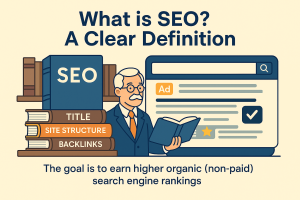
At its core, Search Engine Optimization (SEO) is the art and science of making your website more attractive to search engines. The goal is to earn higher organic (non-paid) search engine rankings.

“Illustration explaining what SEO is, showing books labeled title, site structure, and backlinks beside search results.”

A simple breakdown of what SEO really means — making your website easier for search engines to understand and rank.

Think of search engines like a constantly updated library. SEO is the process of making sure your book (your website) has a compelling title (title tag), a clear table of contents (site structure), valuable content (quality information), and positive reviews from other authors (backlinks). This makes it easy for the librarian (the search engine) to recommend your book when someone asks a relevant question.

It’s crucial to understand the difference between organic search results and paid ads. Paid ads (Pay-Per-Click or PPC) appear at the top of search results with a small “Ad” label. You pay for that placement. Organic results, listed below the ads, are the “natural” listings that SEO aims to improve. While both are important, organic search typically drives the majority of search traffic and is perceived as more trustworthy by users.

  1. How Do Search Engines Work?

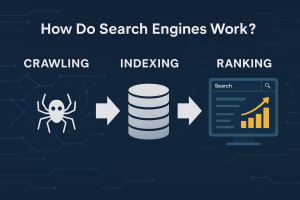
To master SEO, it helps to understand how search engines operate. They perform three primary functions:

Infographic explaining crawling, indexing, and ranking in search engines

How Google discovers, stores, and ranks your website.

  • Crawling: Search engines use automated programs called “bots” or “spiders” to discover publicly available content on the web. They crawl the internet by following links from one page to another.
  • Indexing: After crawling a page, the search engine processes and stores the information in a massive database known as an index. Think of the index as a giant library catalog that contains information about every web page the engine has found.
  • Ranking: When a user types a query, the search engine sifts through its index to find the most relevant and authoritative pages. It then orders these pages into a list of results—this is the ranking process. The complex algorithms that determine this order consider hundreds of factors.
  1. Core Pillars of SEO: A Three-Part Foundation

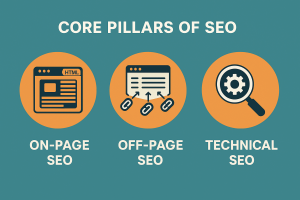
Effective SEO is built on three interconnected pillars:

"Core pillars of SEO infographic featuring on-page, off-page, and technical SEO icons"

The three pillars that shape every successful SEO strategy.

  • Technical SEO: This is the foundation. It involves optimizing the backend of your website so search engines can crawl and index it effectively. Key aspects include site speed, mobile-friendliness, clean URL structures, and a secure (HTTPS) connection. If your site has technical issues, it’s like having a store with a broken door—no one can get in, no matter how great your products are.
  • On-Page SEO: This focuses on optimizing individual web pages to rank higher. It includes elements that both users and search engines see, such as:
    • Keyword Research and Usage: Identifying the terms your audience searches for and using them strategically in your content.
    • Content Quality: Creating valuable, comprehensive, and engaging content that satisfies the user’s search intent.
    • Meta Tags: Crafting compelling title tags and meta descriptions that appear in search results.
    • Header Tags (H1, H2, H3): Structuring your content for readability and relevance.
  • Off-Page SEO: This is about building your website’s reputation and authority across the internet. The most significant factor here is link building—earning backlinks from other reputable websites. These links act as votes of confidence, telling search engines that your content is valuable and trustworthy. Social media mentions and brand citations also contribute to off-page SEO.
  1. Why SEO Matters: The Tangible Benefits

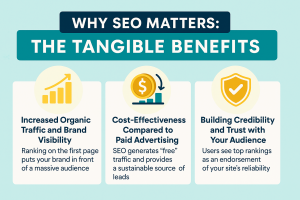
Investing in SEO isn’t just a marketing tactic; it’s a business strategy with powerful returns:

“Infographic explaining benefits of SEO including organic traffic, cost-effectiveness, and credibility”

SEO gives you visibility, trust, and sustainable growth — all in one.

  • Increased Organic Traffic and Brand Visibility: Ranking on the first page of Google puts your brand in front of a massive audience. Even if users don’t click immediately, they see your brand name, building recognition and trust over time.
  • Cost-Effectiveness Compared to Paid Advertising: While SEO requires an investment of time and resources, the traffic it generates is “free” in the sense that you don’t pay for each click. This creates a sustainable source of leads and customers that can compound over time, unlike PPC, which stops the moment you stop paying.
  • Building Credibility and Trust with Your Audience: Users inherently trust search engines. A top organic ranking is seen as an implicit endorsement, signaling that your site is a credible source of information. High-quality SEO, which provides great content and a good user experience, directly builds this trust.
  1. Common SEO Myths and Misconceptions

The world of SEO is filled with outdated advice and myths. Let’s debunk a few:

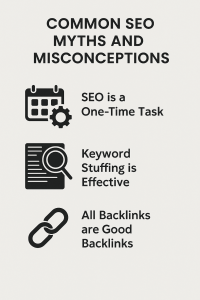
“SEO myths infographic listing common misconceptions with icons”

Don’t fall for these SEO myths — they’re holding your growth back.

  • “SEO is a One-Time Task”: Search engine algorithms are constantly evolving, and competitors are always working to improve their own rankings. SEO is an ongoing process of monitoring, updating, and adapting.
  • “Keyword Stuffing is Effective”: In the early days of SEO, cramming keywords into content could boost rankings. Today, this practice is penalized by search engines. Modern SEO focuses on natural language and user intent.
  • “All Backlinks are Good Backlinks”: The quality of backlinks matters far more than the quantity. A single link from a highly authoritative site like Harvard.edu is worth more than thousands of links from low-quality, spammy directories.
  1. Essential SEO Tools for Beginners

You don’t need a massive budget to start with SEO. Several powerful tools are available:

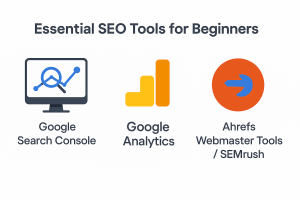
“SEO tools infographic featuring Google Search Console, Google Analytics, Ahrefs, and SEMrush”

Start your SEO journey with the tools that actually matter.

  • Google Search Console: A free tool that shows you how Google views your site. It provides data on your search traffic, indexing status, and any technical errors that need fixing.
  • Google Analytics: Another essential free tool. It helps you understand your website visitors—who they are, how they found you, and what they do on your site.
  • Ahrefs Webmaster Tools / SEMrush: While their full suites are paid, these platforms offer free versions or trials that are excellent for keyword research and competitor analysis.
  1. The Future of SEO: Staying Ahead of the Curve

SEO is not static. To stay competitive, you must be aware of emerging trends:

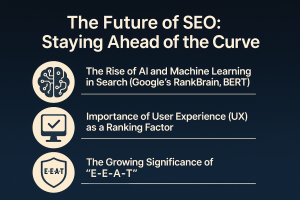
“SEO future trends infographic with AI, UX, and E-E-A-T icons”

The future of SEO is smarter, more human, and driven by trust.

  • The Rise of AI and Machine Learning in Search (Google’s RankBrain, BERT): Google’s algorithms are increasingly focused on understanding user intent, not just keywords. Creating content that naturally answers questions is more important than ever.
  • Importance of User Experience (UX) as a Ranking Factor: Metrics like Core Web Vitals (loading speed, interactivity, visual stability), mobile-friendliness, and overall site usability are now direct ranking factors. A site that is easy and pleasant to use will be rewarded.
  • The Growing Significance of “E-E-A-T”: This stands for Experience, Expertise, Authoritativeness, and Trustworthiness. Google uses these principles to assess the quality of content, especially for “Your Money or Your Life” (YMYL) topics like health, finance, and legal advice. Demonstrating your E-E-A-T is crucial for ranking.

Conclusion: SEO is an Essential Long-Term Investment

Search Engine Optimization is much more than a technical checklist. It is a fundamental marketing discipline that aligns your website with the needs of both your audience and search engines. By creating a technically sound, user-friendly website filled with high-quality, authoritative content, you build a powerful asset that drives sustainable growth.

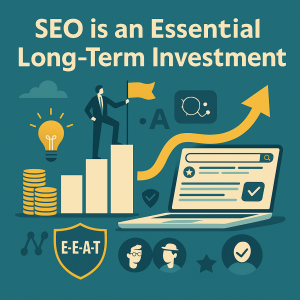
“SEO long-term investment infographic with growth chart and E-E-A-T icons”

SEO pays off over time — build authority, boost traffic, and stay ahead.

While SEO requires patience and consistent effort, the payoff is immense: a steady stream of targeted traffic, increased brand authority, and a significant competitive advantage. In today’s digital world, understanding and implementing SEO isn’t optional—it’s essential for any business that wants to be found online. Start with the basics, focus on providing real value to your users, and you’ll be well on your way to long-term success.


How to Build a Digital Marketing Strategy from Scratch

Team planning digital marketing strategy with whiteboard and laptops

Why Every Business Needs a Digital Marketing Strategy

In today’s crowded digital landscape, having a strategic approach to marketing isn’t just beneficial—it’s essential for survival. Many businesses make the critical mistake of jumping straight into tactics without a clear plan, leading to wasted resources, inconsistent messaging, and disappointing results.

The importance of having a plan before you promote cannot be overstated. A well-crafted strategy acts as your roadmap, ensuring every marketing dollar and hour spent contributes to your ultimate business objectives. It transforms random acts of marketing into a coordinated, purposeful effort that builds momentum over time.

Digital marketing strategy roadmap illustration featuring charts, analytics, and planning visuals.

A smart strategy turns random marketing efforts into consistent growth.

How a clear strategy sets you apart from competitors is equally crucial. While your competitors are posting randomly and chasing the latest “shiny object,” your strategic approach allows you to build brand recognition, foster customer loyalty, and create a sustainable competitive advantage that’s difficult to replicate.

  1. Understand Your Business Goals

Before you can market effectively, you must know what you’re trying to achieve. Vague goals like “get more customers” won’t provide the direction needed for an effective strategy.

Define what success looks like with specific, measurable objectives. Instead of “increase sales,” aim for “increase online sales by 30% in the next quarter” or “generate 50 qualified leads per month.” These clear targets will guide your tactical decisions and help you measure progress.

Digital illustration showing a person looking at a target and upward graph representing business goal setting.

Define clear, measurable business goals to guide your digital marketing strategy effectively.

Align marketing objectives with business outcomes by ensuring your marketing goals directly support broader business objectives. If the company needs to increase average order value, your marketing strategy should focus on upselling and cross-selling rather than just acquiring new customers at the lowest price point.

  1. Identify Your Target Audience

Trying to market to everyone means you’ll resonate with no one. Understanding your ideal customer is the foundation of effective marketing.

Build buyer personas that go beyond basic demographics. Create detailed profiles that include:

  • Job titles and responsibilities (for B2B)
  • Interests and hobbies
  • Challenges and pain points
  • Goals and aspirations
  • Where they seek information
  • Objections they might have to your solution
Identify your target audience concept with illustration of person analyzing audience profiles and target symbol.

Understand who you’re talking to before you market — define your ideal audience and tailor your message.

Understand customer pain points and behavior by conducting surveys, interviewing current customers, and analyzing customer service interactions. This deep understanding allows you to create messaging that directly addresses their needs and speaks their language.

  1. Conduct Market and Competitor Research

Understanding your competitive landscape helps you identify opportunities and threats while shaping your unique position in the market.

Conducting market and competitor research illustration

Dive deep into your market to discover opportunities and outperform competitors.

Analyze your competitors’ online presence by:

  • Reviewing their website and content strategy.
  • Assessing their social media engagement and follower growth.
  • Understanding their SEO strategy through keyword analysis.
  • Evaluating their paid advertising approaches.
  • Reading customer reviews and feedback.

Find your unique positioning and value proposition by identifying gaps in the market that your competitors aren’t filling. Perhaps they’re all targeting enterprise clients while neglecting small businesses, or maybe they focus on price while customers actually value premium service and support.

  1. Choose the Right Digital Marketing Channels

With numerous channels available, selecting the right mix is critical for efficient resource allocation and maximum impact.

SEO, social media, PPC, email, and content marketing each serve different purposes:

  • SEO: Long-term organic growth and credibility.
  • Social Media: Brand building and community engagement.
  • PPC: Immediate traffic and testing opportunities.
  • Email Marketing: Customer retention and nurturing.
  • Content Marketing: Authority building and organic reach.
Digital marketing channels illustration – SEO, social media, PPC, email, content marketing

Select the digital channels that drive your brand’s growth.

How to prioritize based on your budget and goals: If you have limited resources, focus on 2-3 channels that align best with your audience and objectives. A B2B company might prioritize LinkedIn and SEO, while a fashion brand might focus on Instagram and influencer partnerships.

  1. Create a Strong Brand Message and Content Plan

Your messaging is what connects emotionally with your audience, while your content plan ensures consistent communication.

Craft messaging that connects by developing a clear value proposition and brand story. Your messaging should:

  • Clearly articulate what you do and for whom.
  • Explain why you’re different and better.
  • Resonate emotionally with your target audience.
  • Be consistent across all touchpoints.
Creating a strong brand message and content strategy illustration

Craft a story your audience connects with and content they crave.

Plan content formats: blogs, videos, infographics, and ads based on your audience preferences and resources. Create a content calendar that balances:

  • Educational content that addresses pain points.
  • Entertaining content that builds brand personality.
  • Promotional content that drives conversions.
  • User-generated content that builds social proof.
  1. Set a Realistic Budget and Timeline

A strategy without proper resource allocation is merely a wish list. Realistic budgeting and timing are what bring your plan to life.

Allocate resources for tools, ads, and creative work by considering:

  • Marketing software and tools (CRM, analytics, design).
  • Advertising spend (PPC, social media ads).
  • Content creation (writers, designers, videographers).
  • Agency or freelance support if needed.
Budget and timeline planning for digital marketing illustration

Plan your marketing budget and timeline to balance creativity and results.

Plan short-term and long-term marketing milestones to maintain momentum and measure progress. Set 30, 60, and 90-day goals that lead toward your quarterly and annual objectives. This approach allows for regular assessment and adjustment.

  1. Develop and Implement Your Campaigns

Execution is where strategy meets reality. A disciplined implementation approach ensures your plan delivers results.

Step-by-step execution for each channel might include:

  • SEO: Technical audit, keyword mapping, content creation.
  • Social Media: Profile optimization, content calendar, engagement plan.
  • Email: List building, sequence creation, automation setup.
  • PPC: Account structure, keyword research, ad creation.
Develop and implement digital marketing campaigns illustration

Plan, execute, and track your marketing campaigns for consistent growth.

Importance of consistency and cross-channel synergy cannot be overlooked. Ensure your messaging is consistent across channels while tailoring the format to each platform’s best practices. Coordinate campaigns so they work together—for example, promoting your blog content through social media and email newsletters.

  1. Track Performance and Analyze Data

What gets measured gets improved. Regular performance analysis turns your marketing from a cost center into a profit driver.

Use analytics tools to measure KPIs and conversions by tracking metrics that matter:

  • Website traffic and behavior.
  • Conversion rates at each stage of the funnel.
  • Customer acquisition cost (CAC).
  • Return on investment (ROI).
  • Engagement rates on social media.
  • Email open and click-through rates.
Marketer analyzing data charts and performance graphs

Track your performance and make data-driven decisions

How to turn data into insights for better decisions involves looking beyond surface-level metrics to understand the “why” behind the numbers. If a blog post is generating significant traffic but no conversions, perhaps the call-to-action needs improvement, or the offer isn’t compelling enough.

  1. Optimize and Scale Your Strategy

A digital marketing strategy is a living document that should evolve based on performance data and market changes.

A/B testing, automation, and continuous improvement should be built into your process. Regularly test:

  • Ad copy and visuals.
  • Email subject lines.
  • Landing page elements.
  • Call-to-action buttons and placement.
A/B testing and optimization in digital marketing strategy

Fine-tune your marketing with A/B testing and data-driven optimization.

Scaling what works and dropping what doesn’t is the key to efficient growth. Double down on channels and tactics that deliver the best ROI, while eliminating or improving underperforming activities. This might mean reallocating budget from low-performing social channels to high-converting search ads.

  1. Stay Updated with Digital Trends

The digital landscape changes rapidly. Staying current ensures your strategy remains effective and competitive.

Stay updated with digital marketing and AI trends

Keep your marketing strategy fresh by staying informed on the latest digital innovations.

How to adapt to algorithm changes and AI tools requires:

  • Following industry thought leaders and publications.
  • Participating in relevant forums and communities.
  • Testing new features and platforms cautiously.
  • Implementing AI tools for efficiency while maintaining human oversight.

Keeping your strategy relevant in 2025 and beyond means embracing trends like:

  • Voice search optimization.
  • Video-first content.
  • Personalization at scale.
  • Privacy-first marketing approaches.
  • AI-enhanced content creation and analysis.
Future-proof your digital marketing strategy with AI and personalization

Stay ahead of the curve with emerging digital trends that define the future of marketing.

Conclusion: From Scratch to Success

Building a digital marketing strategy from scratch may seem daunting, but following this systematic approach transforms an overwhelming task into an achievable process.

From Scratch to Success motivational marketing graphic

From vision to victory — every strong marketing strategy starts with the right steps.

Recap of the key steps:

  1. Start with clear business goals.
  2. Deeply understand your target audience.
  3. Research your market and competitors.
  4. Select the right channel mix.
  5. Develop compelling messaging and content.
  6. Allocate appropriate resources.
  7. Execute with consistency.
  8. Measure everything.
  9. Optimize based on data.
  10. Stay current with trends.

Final thoughts on building a strategy that lasts: Remember that your first strategy won’t be perfect—and it shouldn’t be. The most successful marketers view their strategy as a flexible framework that evolves based on data, customer feedback, and market changes. Start implementing, measure your results, learn quickly, and iterate. The businesses that thrive in the digital age aren’t those with perfect strategies, but those that are strategic in their approach to learning and adaptation.