
For years, digital marketing has been dominated by sight: video, display, and social feeds. But in a world suffering from screen fatigue, the audience’s attention is shifting to the oldest, most intimate medium of all: audio.

When screens overwhelm, audio connects.
Brands that are truly winning on platforms like Spotify and across the podcast ecosystem are looking past the standard 30-second pre-roll spot. They are moving from audio advertising to audio storytelling, embedding their identity into the listening experience itself.
Here is the blueprint for an audio-first strategy that drives trust, not tune-outs.
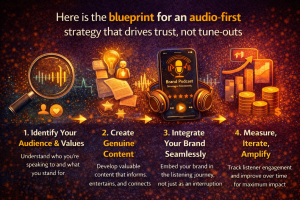
From audience insight to measurable impact, this is how audio strategies actually work.
- Why Audio-First Marketing Is Rising
Audio is uniquely positioned in the modern media landscape. It doesn’t require a screen and accompanies the listener during key moments of their day: commuting, working out, or cooking.
- Trust, Intimacy, and High Recall: Listening through earbuds or in a car is a deeply personal experience. A human voice sharing a story fosters a connection that a fleeting video ad often cannot replicate. This intimacy leads to higher recall—listeners remember audio messages more than billboards.
- Why Audiences Prefer Voice-Led Content: Listeners actively choose their podcasts or playlists, creating a “lean-in” environment. When ads feel less intrusive and more integrated, they are welcomed as content, not interruptions.
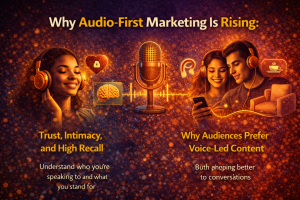
Audio builds trust where screens create fatigue. That’s why brands are leaning into voice-led marketing.
- The Problem With Traditional Audio Ads
The basic programmatic audio ad is suffering from the same issues as banner blindness.
- Ad Fatigue: Repeatedly hearing the same, often generic, 15-30 second spot creates resentment and the immediate urge to skip (if possible).
- Low Engagement During Forced Breaks: Standard ads interrupt the flow of content, turning an active listening moment into a passive, screen-gazing moment, or worse, a moment of distraction.
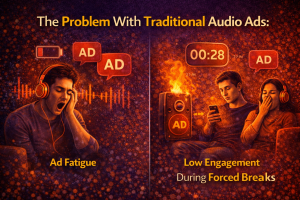
Listeners experiencing ad fatigue and low engagement during forced traditional audio advertisements
- Branded Podcast Segments
Instead of buying a slot before or after an episode, a branded segment integrates the brand into the core content.
- Integrated Storytelling: The brand funds a recurring, relevant section of the show. For example, a financial services brand sponsoring “The Market Movers” segment where the host breaks down the week’s economic news.
- Borrowing Host Authority: The host, who has earned the listener’s trust, introduces the segment, effectively giving the brand their implicit endorsement. This is less like an ad and more like a collaboration. (See examples like Choiceology by Charles Schwab).
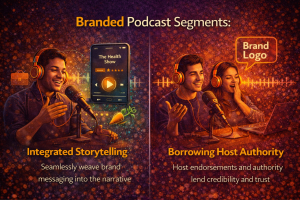
Don’t interrupt the story. Become part of it.
- Host-Read Native Mentions
This is the ultimate high-trust script. The key is to keep it natural and avoid the over-promotional tone.
- Natural, High-Trust Scripts: The host reads the script in their own voice, often adding personal context or a quick anecdote about how they genuinely use the product. This makes the pitch feel like advice from a friend.
- Best Use Cases: Ideal for products that are easily integrated into the host’s lifestyle (e.g., productivity apps, meal kits, comfortable clothing, or specialized software).
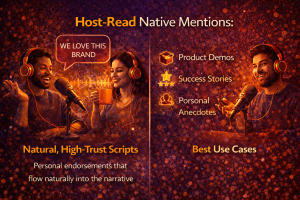
When hosts believe it, audiences feel it.
- Sponsored Playlists
Spotify offers a unique, mood-based entry point for brands to connect with listeners who are not actively seeking conversation.
- Mood-Based Branding: A car manufacturer sponsors “The Ultimate Road Trip Playlist.” A coffee brand sponsors “Focus Flow: Deep Work Beats.” The brand owns the feeling and context of the listening moment, fostering a positive association.
- Creator-Driven Curation: Brands can partner with influential playlist curators on Spotify to access their ready-made, highly engaged audiences, ensuring the playlist content feels authentic to the listener. Sponsoring personalized playlists like “Discover Weekly” or “On Repeat” connects the brand with the user’s current music habits.
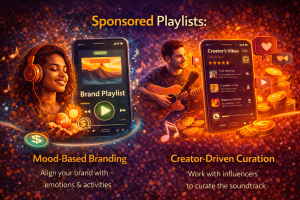
Turn moods into moments. Sponsored playlists let brands live inside the soundtrack of everyday life.
- Mini Audio Series
This is the branded content evolution of the blog post—creating short, episodic, and highly focused audio content.
- Short-Form Episodes: Episodes are typically 5-10 minutes long, designed for a micro-moment (like a morning commute). The content focuses entirely on educating or entertaining, with the brand taking a backseat.
- Story-Led Brand Building: Brands like GE have launched successful sci-fi podcasts (The Message) that never mention the product, but embody the brand’s spirit of innovation and technology.
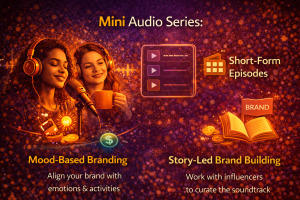
Short episodes. Long-term brand love.
- Sonic Branding
Sonic branding, or the creation of a recognizable sound signature, ensures your brand is recognized in screenless environments.
- Sound Signatures: This is the short, unique sound (or “audio logo”) that immediately cues your brand. It must be consistent across all audio touchpoints—ads, smart speaker interactions, and even phone hold music.
- Boosting Brand Recognition: When the sonic logo is effective, brands can achieve high recognition even without stating their name, as McDonald’s demonstrated in a recent campaign.
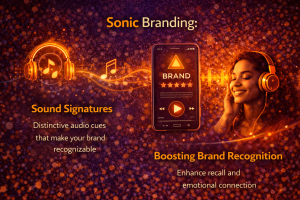
When your brand becomes recognizable by sound alone.
- Measuring What Matters
Clicks are a limited metric in audio. Success is measured by deeper, upper-funnel indicators.
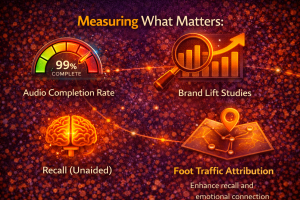
Because plays mean nothing without impact.
- Audio Completion Rate
- Why It Matters: Shows the percentage of ads heard fully (typically high, >90%).
- Measurement Tool: Streaming Platform Analytics
- Brand Lift Studies
- Why It Matters: Measures changes in awareness, favorability, and purchase intent between exposed vs. control groups.
- Measurement Tool: Third-party survey providers (Nielsen, Kantar)
- Recall (Unaided)
- Why It Matters: Measures if the audience remembers the brand or message without prompting.
- Measurement Tool: Post-campaign surveys
- Foot Traffic Attribution
- Why It Matters: For retail/physical goods, measures store visits after listeners are exposed to a geo-targeted ad.
- Measurement Tool: Location analytics platforms
- Common Mistakes
- Over-Promotional Scripts: Sounding like a loud, rushed radio announcer breaks the intimate connection of the platform.
- Poor Audience Alignment: Sponsoring a fitness podcast for an audience of retirees. The message must fit the mood and demographic.
- Retrofitting Video/Text Ads: An audio-first strategy means the message must be conceptualized for sound, not just copied from a video script.
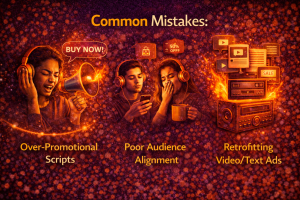
Why most audio campaigns fail before they even start.
- Your Audio-First Action Plan
Choosing Formats
- If budget is low & audience is niche: Start with Host-Read Native Mentions on a small, highly relevant podcast.
- If the goal is awareness & scale: Invest in Sponsored Playlists and a strong Sonic Brand.
- If the goal is thought leadership & trust: Commit to a Mini Audio Series or a Branded Podcast Segment.
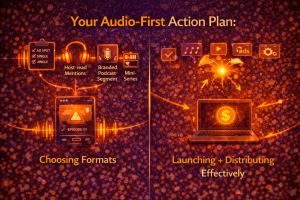
A practical roadmap for launching and scaling an audio-first marketing strategy that actually converts.
Launching + Distributing Effectively
Remember: Audio is not just distribution; it’s creation. You must align your tone, format, and content to the unique consumption habits of listeners to truly win outside of the standard ad slot.

Leave a Reply