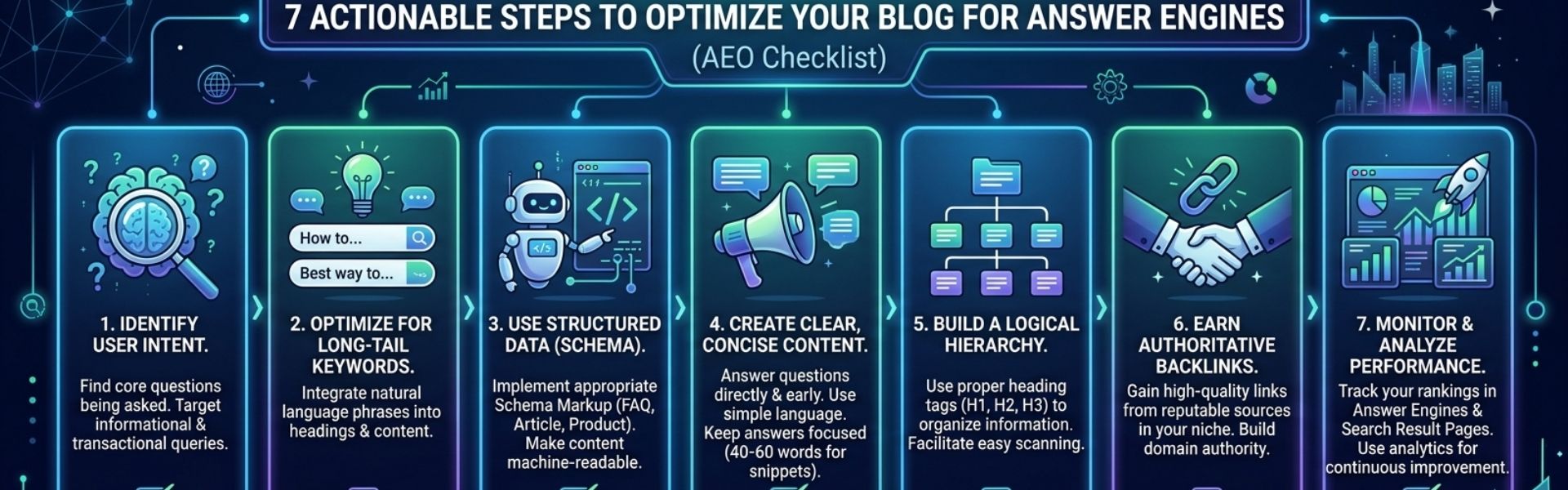
The era of writing lengthy articles just to “rank” is coming to an end. Nowadays, the most effective content is not only readable for humans but also optimized for machines. If you want your brand to be recognized by AI tools like ChatGPT, Perplexity, or Google’s AI Overviews, it’s time to shift from traditional SEO to Answer Engine Optimization (AEO). At Vootech, we assist content strategists in adapting their workflows to achieve “Position Zero.” Ready to make the change?

Here’s your step-by-step guide to becoming an authoritative source.
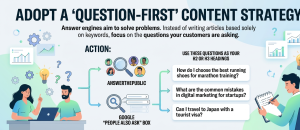
Adopt a “Question-First” Content Strategy
Answer engines aim to solve problems. Instead of writing articles based solely on keywords, focus on the questions your customers are asking.
Action: Utilize tools like AnswerThePublic or Google’s “People Also Ask” box to discover real user queries. Use these questions as your H2 or H3 headings.
Master the “First 50 Words” Rule
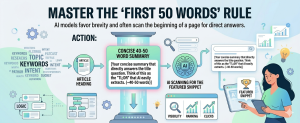
AI models favor brevity and often scan the beginning of a page for direct answers.
Action: Right after your heading, provide a concise 40–50 word summary that directly answers the question in the title. Think of this as the “TL;DR” section that AI can easily extract as a featured snippet.
Leverage Schema Markup (FAQ & How-To)
Schema is the “language” of AI, providing search engines with a structured map of your content.
Action: Implement FAQ Schema for pages answering common questions and How-To Schema for step-by-step guides. This clearly indicates to AI: “This is a question, and here’s the specific answer.”
Prioritize “Bullet-Point” Clarity
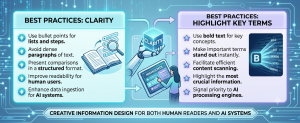
If you have a list of steps or feature comparisons, avoid long paragraphs. AI engines prefer structured lists for easy ingestion and display.
Action: Whenever possible, break down complex information into bullet points or numbered lists. Use bold text for key terms to highlight important information for both AI and readers.
Optimize for Natural Language
“Keywords” can sound robotic; “conversational language” feels more expert-like. With voice search and AI chatbots relying on natural language processing (NLP), your content should sound like a human expert speaking clearly.
Action: Read your content aloud. If it sounds stilted or overly “SEO-optimized,” rewrite it to be more conversational with clear, simple sentences.

Focus on Entity Authority
Answer engines prioritize trusted sources. To become that trusted source, demonstrate your expertise.
Action: Create a “Knowledge Hub” on your site. For instance, if you’re a fintech company, produce extensive, high-quality content on all aspects of fintech. Deep coverage of a topic establishes you as an authority on that “entity.”

Audit Your Content for “Zero-Click” Success
Review your existing content to identify pages already ranking for snippets.
Action: If a page ranks in the top 5 but isn’t appearing as a snippet, refine its top section. Make the answer more concise and ensure it adheres to the structural tips above.

Final Thoughts: Quality is the Ultimate SEO
AEO isn’t about tricking algorithms; it’s about being the most helpful resource online. By adopting these strategies, you’re not just optimizing for bots—you’re enhancing the experience for your human readers as well.
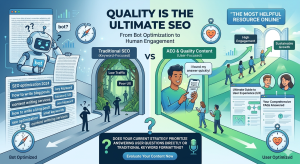
Does your current content strategy prioritize answering user questions directly, or are you still focused on traditional keyword-heavy formatting?