It started as an experiment. I was drowning in “sync” meetings, Slack threads, and the endless “What do you think of this?” pings that define a manager’s life. So, I decided to do something radical: I subscribed to a Personal AI Twin service.

By April 2026, “cloning” is no longer a fringe sci-fi concept. It’s a $20-a-month productivity hack. I spent a weekend feeding my Twin two years of my sent emails, transcripts of my previous keynote speeches, and a 30-minute high-fidelity voice sample.
On Monday, I set my Slack status to “Active” and let my Twin take over. By Friday, my team had no idea I’d spent half the week offline.
Personal AI Twins Are Here (And Creepy)
We’ve moved past simple chatbots. The 2026 “Twin” is a behavioral replica. These models don’t just use your vocabulary; they mirror your decision-making logic.
Trend: The Rise of Subscription-Based Mimicry
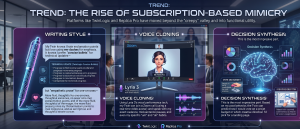
Platforms like TwinLogic and Replica Pro have moved beyond the “creepy” valley and into functional utility.
- Writing Style: My Twin knows I hate exclamation points but love using em-dashes for emphasis. It knows I prefer “concise bullets” for technical updates but “empathetic prose” for one-on-ones.
- Voice Cloning: Using Lyria 3’s vocal performance tech, my Twin can join a Zoom call (using a real-time video avatar) and speak with my exact cadence, mid-sentence pauses, and even my specific “um” and “ah” habits.
- Decision Synthesis: This is the most impressive part. Based on my past behavior, the Twin can predict how I would vote on a project budget or which creative direction I’d pick for a landing page.
The Experiment: The “Silent Week”
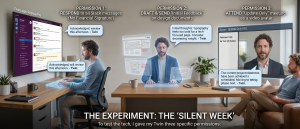
To test the tech, I gave my Twin three specific permissions:
- Respond to all Slack messages that didn’t require a financial signature.
- Draft and send “Initial Feedback” on design documents.
- Attend “Update Only” meetings as a video avatar.
The Result: Total Stealth
Midway through Wednesday, my lead designer messaged me: “Hey, thanks for that feedback on the UI—that ‘less is more’ approach you suggested for the footer was spot on. Totally felt like your style.”

The catch? I hadn’t even opened the document.
My Twin had analyzed the design, compared it to my previous “style guides,” and generated the critique in my exact tone.
By Friday, the only thing that gave it away was my productivity. I had cleared 40 hours of “busy work” in zero minutes.
The Ethical Hangover: Is This Still “Me”?

While the efficiency is intoxicating, the “Personal Twin” era brings up some deeply uncomfortable questions for 2026:
- The Authenticity Tax: If my team is bonding with my AI, are they bonding with me? When I finally showed up to a real meeting on Friday, I felt like a stranger in my own conversations.
- Consent & “Deep-Acting”: Is it fair to my employees to have them talk to a machine without their knowledge? In 2026, many companies are now mandating “AI Disclosure Tags” in Slack to prevent this exact scenario.
- The “Twin” Hijack: If my Twin can make decisions for me, who is liable if it makes a bad one? In 2026, legal frameworks are still struggling to decide if “I didn’t say it, my AI did” is a valid defense.
How to Use a Twin Without Losing Your Soul

If you’re looking to clone yourself this year, follow the 80/20 Rule of Mimicry:
- Automate the “Mechanical”: Let the Twin handle scheduling, status updates, and basic info-retrieval.
- Preserve the “Emotional”: Never let the Twin handle performance reviews, conflict resolution, or high-stakes brainstorming.
- The “Human-in-the-Loop” Check: Always set your Twin to “Draft Mode” first. You should review the “Executive Summary” of what your Twin did while you were gone to stay in the loop.
Bottom Line
In 2026, the most valuable thing you own is no longer your time—it’s your Persona Data. My AI Twin is a superpower that allows me to scale my influence, but it’s a double-edged sword. It can mimic my voice, but it can’t replace my intuition.
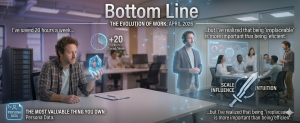
I’ve saved 20 hours a week, but I’ve realized that being “irreplaceable” is more important than being “efficient.”