
In 2026, the way we search has fundamentally changed. When a customer wants to know where the closest high-rated café is or how to troubleshoot a recurring software bug, they aren’t typing keywords into a search bar—they’re asking their phone, their car, or their smart speaker.
With over 20% of the global population now using voice search, the “10 blue links” are disappearing. In their place is a single, spoken answer provided by an AI assistant.
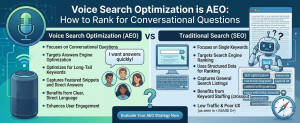
At Vootech, we view Voice Search not as a separate discipline, but as a core component of Answer Engine Optimization (AEO). If you want your business to be the “voice” that AI assistants recommend, you need to stop writing for scanners and start writing for listeners.
Why Voice Search is the Ultimate AEO Frontier
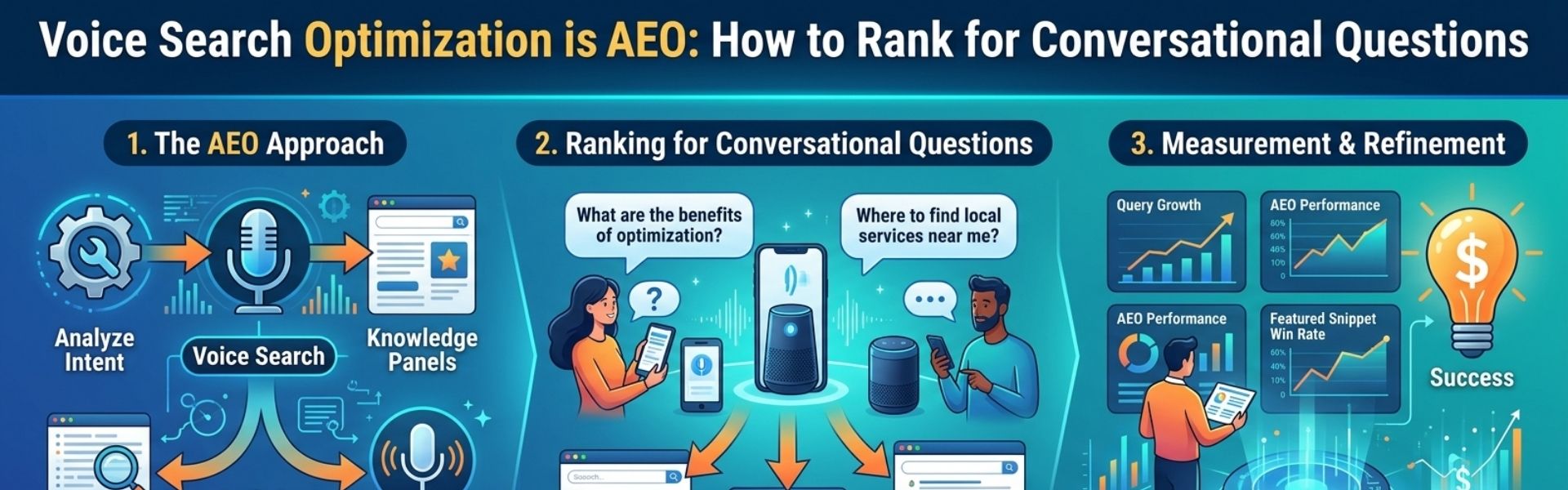
Voice search is inherently conversational and local. When a user asks a question via voice, they aren’t using “search-speak” (e.g., “plumber Seattle”). They are asking full, natural questions (e.g., “Who is the highest-rated plumber in Seattle that can come out today?”).
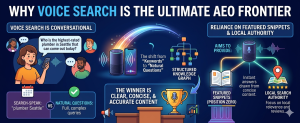
Because voice assistants aim to provide the most helpful, immediate answer, they rely heavily on Featured Snippets and Local Search authority. If your content is the most clear, concise, and accurate response to that conversational query, you win.
The “Near Me” & Conversational Playbook
To capture these high-intent searches, your content strategy needs to evolve. Here are the four pillars of optimizing for voice and conversational AI:
- Optimize for “Natural” Long-Tail Phrases
Stop obsessing over fragmented keywords. Instead, build your content around the “5 Ws” (Who, What, Where, When, Why) and “How.”
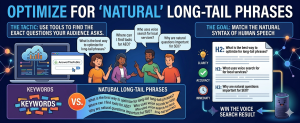
- The Tactic: Use tools like AnswerThePublic to find the exact questions your audience asks. Incorporate these into your H2 and H3 headings.
- The Goal: Match the natural syntax of human speech.
- The Power of “Position Zero” (Featured Snippets)
Voice assistants frequently pull their answers directly from featured snippets. If you aren’t in that box, you aren’t in the conversation.
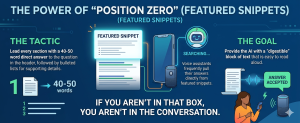
- The Tactic: Lead every section with a 40-50 word direct answer to the question in the header, followed by bulleted lists for supporting details.
- The Goal: Provide the AI with a “digestible” block of text that is easy to read aloud.
- Hyper-Local Entity Authority
76% of voice searches have local intent. For mobile-first businesses, this is your biggest opportunity.
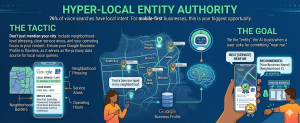
- The Tactic: Don’t just mention your city. Include neighborhood-level phrasing, clear service areas, and your operating hours in your content. Ensure your Google Business Profile is flawless, as it serves as the primary data source for local voice queries.
- The Goal: Be the “entity” the AI trusts when a user asks for something “near me.”
- Technical Hygiene (The Foundation of Trust)
AI assistants prioritize sites that are fast, secure, and structured.
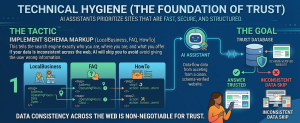
- The Tactic: Implement Schema Markup (LocalBusiness, FAQ, and HowTo). This tells the search engine exactly who you are, where you are, and what you offer. If your data is inconsistent across the web, AI will skip you to avoid giving the user wrong information.
Voice Search Checklist for 2026
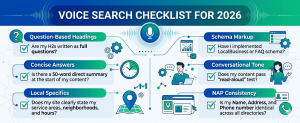
- Question-Based Headings: Are my H2s written as full questions?
- Concise Answers: Is there a 50-word direct summary at the start of my content?
- Local Specifics: Does my site clearly state my service areas, neighborhoods, and hours?
- Schema Markup: Have I implemented LocalBusiness or FAQ schema?
- Conversational Tone: Does my content pass the “read-aloud” test?
- NAP Consistency: Is my Name, Address, and Phone number identical across all directories?
The Vootech Bottom Line
Voice search isn’t a “future trend”—it’s a current reality. By adopting these conversational AEO tactics, you aren’t just ranking; you are positioning your brand to be the definitive answer in a voice-first world.

Is your content strategy optimized for the way your customers actually speak, or are you still relying on keyword-stuffed titles?